The First Upgrades Worth Making to a Stock E-Bike (2026)
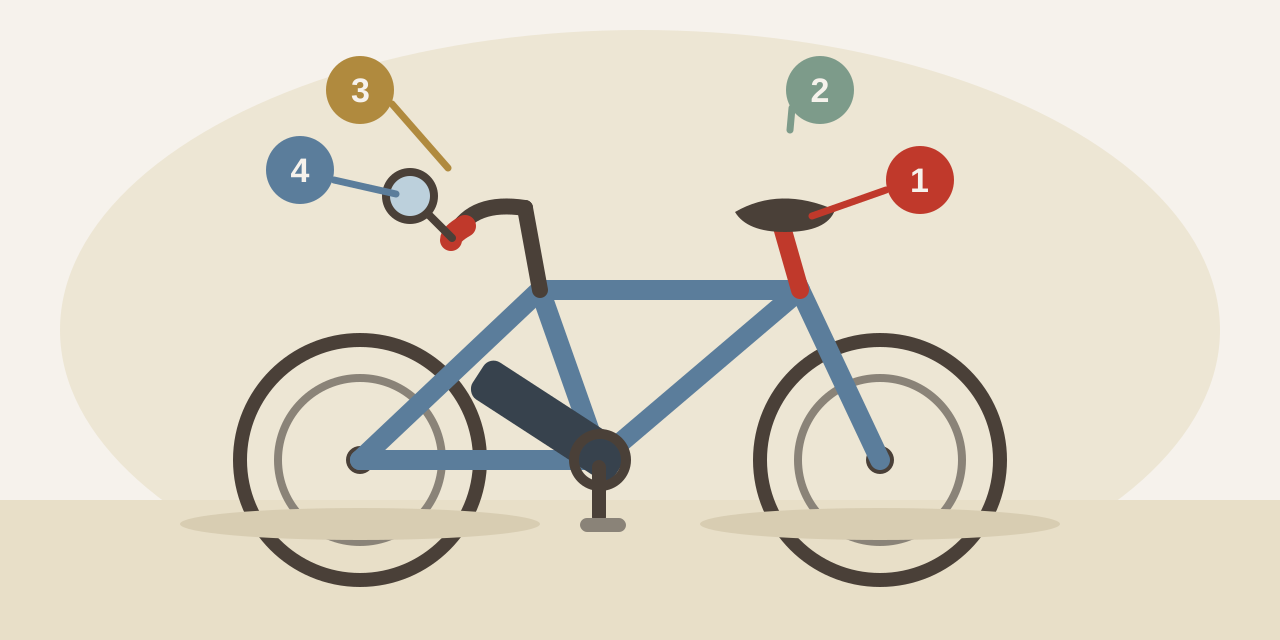
Asked what upgrade actually mattered, e-bike owners keep giving the same unglamorous answer: the seat and the seatpost. The comfort stack that fixes the heavy-bike harshness problem, in the order that pays, and the free tune-up check to do first.
Some links below are affiliate links. If you buy through them, EbikeTested may earn a commission at no extra cost to you. Commissions never touch a score, and the failures get published anyway. Full details on our affiliate disclosure page.
Stock e-bikes ship harsh, because comfort parts are where manufacturers hit their price point. The bike's motor, battery and frame ate the budget; the saddle, grips and pedals are placeholders. That is why, when r/ebikes asked "best upgrades you made" this week, the top answer was not electronics — it was "a gel seat and a suspension seat post."
- First, spend nothing: have a shop check the stock setup. One rider's "terrible" e-bike was transformed free when a mechanic found several assembly problems the owner had been riding around on.
- The single biggest comfort change is a suspension seatpost — on a heavy, fat-tired bike that transmits every crack in the pavement up your spine, ~50mm of travel under the saddle does more than any saddle alone. Buy by seatpost diameter, not vibes.
- Then the saddle: a wide cruiser saddle matches the upright geometry most e-bikes ship with — the narrow sport saddle on the bike assumes a lean you are not doing.
- Then hands and eyes: ergonomic lock-on grips for the numbness, and a bar-end mirror — the item riders in the "feature you'd never give up" thread defend hardest per dollar.
Everything here is under roughly $120, none of it voids a motor warranty, and all of it transfers to your next bike.
Why stock e-bikes ride harsh, and why that is fixable for cheap
An e-bike maker building to a $1,200 price has to put the money where the spec sheet is: motor wattage, battery capacity, display. The contact points — saddle, grips, pedals — are line items to minimize, because nobody comparison-shops on saddle quality. The result is a category-wide pattern: bikes that are mechanically fine and genuinely unpleasant to ride for more than twenty minutes.
E-bikes then make the placeholder problem worse than it is on a regular bike, for three compounding reasons. They are heavy — often 60 to 85 lb — so the bike absorbs less and transmits more. They are fast for what they are, so you hit the same pavement defects harder and more often. And they are mostly ridden upright, which plants more of your weight on the saddle and puts road shock straight up the seatpost into your spine instead of into bent elbows the way a leaned-over road position does.
The good news hiding in that diagnosis: every one of those force paths runs through a $30–$110 replaceable part. You cannot cheaply make the bike lighter, but you can change what happens in the last few inches before the road reaches you. That is the whole logic of the comfort stack, and it is why the community's answer to "best upgrade" is so consistently boring.
Step zero costs nothing: get the stock setup checked
Before buying anything, one thread from this cycle deserves its own section. A rider took a flat tire to a shop an hour away and got the bike back transformed: the mechanic had found and fixed several problems for free — things the owner had assumed were just how the bike rode. "He didn't think they were broken, he just thought I had a crappy e-bike."
Direct-to-consumer e-bikes arrive in boxes and get assembled by their owners, and the assembly defaults are wrong for almost everyone: saddle at the factory height, bars rolled to whatever angle survived shipping, tires at whatever pressure the warehouse left in them. Tire pressure alone is a comfort upgrade nobody pays for — fat tires run at their maximum printed pressure ride like wood, and dropping to the low-middle of the printed range is a suspension system you already own. Saddle height set so your leg nearly extends changes how much weight the saddle carries at all.
So the honest order is: pressures and fit first, a shop once-over if anything feels off, and only then the parts below — measured against a bike that is actually set up right. If the thread rider had bought a new saddle for a bike with those assembly problems, he would have reviewed the saddle unfairly and kept the real problem.
Upgrade one: the suspension seatpost, and how to buy the right one
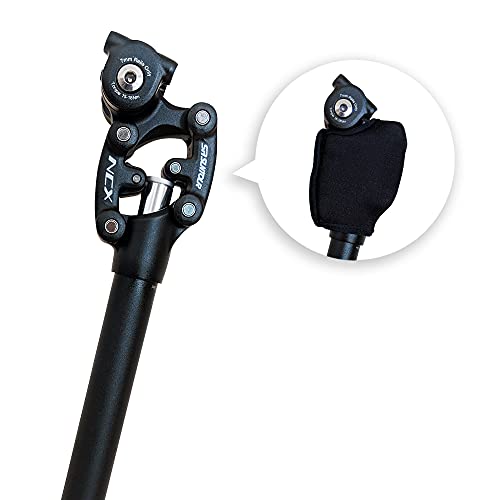
The SR Suntour SP12 NCX is the default answer across e-bike forums, and the design is why: instead of a simple spring that squishes straight down (and pogo-bounces on pedal strokes), its parallelogram linkage swings the saddle down and rearward through an arc. Bumps arrive at an angle, not vertically, and the arc matches that — while keeping saddle-to-pedal distance close to constant, so it does not feel like the floor dropping out mid-stroke. It is listed with about 50mm of travel and, per SR Suntour, a stock spring suited to riders roughly 140–195 lb, with firmer springs available for heavier riders — worth taking seriously on a cargo or commuter bike carrying loads.
The buying detail that causes most returns: diameter. Seatposts come in 27.2, 30.9 and 31.6mm and each is a separate listing. Do not guess — pull your current post and read the diameter stamped near its base, or measure with calipers. If your bike runs an uncommon size, shims exist to fit a 27.2 post into a larger tube, but never the reverse. Check minimum-insertion marks after install: a suspension post is longer-bodied than a rigid one and very tall riders on small frames should confirm there is enough post in the tube.
Two honest caveats. This adds listed weight of about 1.9 lb over a rigid post — irrelevant on an 80 lb bike, mentioned for completeness. And a suspension post fixes what reaches your spine, not your wrists; if your harshness arrives through the bars, that is a different part (see the grips section, and the suspension-stem note at the end).
Upgrade two: a saddle that matches how you actually sit
The community's "gel seat" half of the answer needs one qualification: the right saddle is about width and posture before padding. Sit upright — as e-bike geometry has you do — and your weight lands on your sit bones, spread wide. The narrow sport saddle your bike likely shipped with is shaped for a forward lean that moves weight onto your hands and thighs. Uprightness plus narrow saddle is the recipe for the numb, bruised feeling riders misdiagnose as needing more gel.
For upright riding, a wide cruiser-pattern saddle like the Cloud-9 Cruiser Select — listed at 10.5 x 10.75 inches, with a vented anatomic relief channel — supports the sit bones instead of pressing on soft tissue. The Sunlite Cloud-9 sprung version adds coil springs under the shell; note that sprung saddle and suspension seatpost are alternatives more than a stack — if you have the SP12, buy the unsprung saddle and let the post do the suspending, rather than paying twice for bounce.
Give any new saddle two weeks before judging it. Sit bones adapt, and the first three rides on a different shape always feel wrong. If pain persists past that — numbness in particular — the saddle is the wrong width or the setback is off, and a shop fitting visit costs less than a third saddle.
Upgrades three and four: hands and rearward vision
Grips. Hand numbness on an e-bike is the wrist-angle version of the saddle problem: stock cylindrical grips concentrate pressure on the ulnar nerve, and the fix is a platform. Ergon's GP1 lock-on grips are the category standard — a flat wing supports the heel of your hand and spreads load across the palm, and the lock-on collar means they cannot rotate under a heavy rider's weight the way slide-on rubber does. They come in S and L (this listing is Large); riders with smaller hands take S. Set the wing angle so your wrist is straight when seated in your normal posture — a two-minute Allen-key adjustment that is most of the benefit.
Mirror. In the thread on small features riders would never give up, mirrors keep coming up above far more expensive kit, and e-bike speed is why: at 20–28 mph you close on traffic situations faster and shoulder-checking costs more stability than it did at 12 mph. The Hafny bar-end mirror uses a stainless steel lens — the spec that matters, because a mirror on a bike that gets leaned against racks will get hit, and glass lenses on cheap mirrors are consumables. It mounts inside the bar end (fits roughly 15–23mm internal diameter; you cut a hole in closed grips or use open-ended ones like the GP1s, which pair neatly). Listed weight is about 0.2 lb.
Pedals, the quiet third. Stock e-bike pedals are usually the cheapest part on the whole machine — small plastic platforms that get slick in rain. Aluminum platform pedals with pins fix wet-shoe slip for around $30; any 9/16-thread set fits. Worth it the first time your foot slips off under power.
The comfort stack, in buying order
| Order | Part | What it fixes | Buying detail that matters |
|---|---|---|---|
| 0 | Shop check + tire pressure | Assembly defects you've normalized; wooden ride | Free. Drop fat tires to low-middle of the printed range before judging anything else. |
| 1 | SR Suntour SP12 NCX seatpost | Road shock reaching your spine on a heavy bike | Match stamped diameter: 27.2 / 30.9 / 31.6mm are separate listings. Stock spring ~140–195 lb. |
| 2 | Cloud-9 cruiser saddle | Sit-bone pain from a narrow saddle ridden upright | Width first, gel second. Unsprung if you bought the seatpost; sprung if you didn't. |
| 3 | Ergon GP1 grips | Hand numbness, rotating stock grips | S or L by hand size; set wing angle for a straight wrist. Open ends take a bar-end mirror. |
| 4 | Hafny bar-end mirror | Shoulder-checking at 20+ mph | Stainless lens survives the rack lean-overs that kill glass mirrors. |
| 5 | Alloy platform pedals | Wet-shoe slip off plastic stock pedals | Any 9/16 thread fits. Pins beat rubber. |
The hardware
Selected from what e-bike owners repeatedly name in the threads linked above, checked against manufacturer specifications. EbikeTested has not bench-tested these parts; travel figures, weight ratings and dimensions are the manufacturers' claims. Prices move constantly, so we do not quote them. Confirm your seatpost diameter and grip size before ordering — both are the returns traps in this category.
Community-namedSR Suntour SP12 NCX suspension seatpost (27.2mm)
The upgrade the r/ebikes thread named first. Parallelogram design, ~50mm travel, stock spring rated for roughly 140–195 lb riders with firmer springs available. This listing is 27.2 x 350mm — check the diameter stamped on your current post; 30.9 and 31.6 versions are separate listings. Listed at 1.9 lb.
Check price on Amazon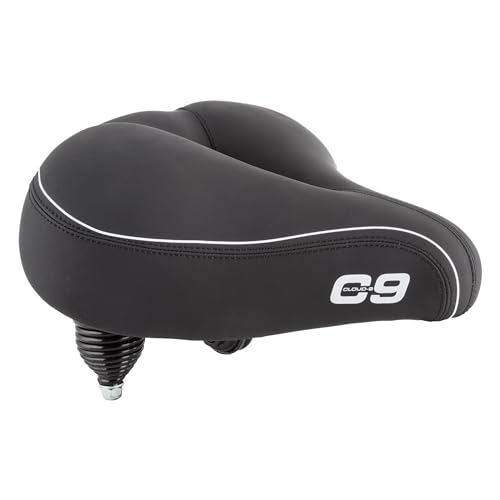 For upright riding
Cloud-9 Cruiser Select saddle
Wide (listed 10.5 x 10.75 in) sit-bone-support shape with a vented relief channel, matched to the upright posture nearly every commuter e-bike ships with. The unsprung choice for anyone running a suspension seatpost. Soft-touch vinyl cover, listed at 3.2 lb.
Check price on Amazon Hands
HandsErgon GP1 lock-on grips (Large)
The ergonomic-grip standard: a supportive wing that spreads palm pressure off the ulnar nerve, with a lock-on collar that will not rotate under load. Sized S/L — this is the Large; smaller hands take S. Open bar ends pair directly with a bar-end mirror.
Check price on Amazon Cheapest safety per dollar
Hafny bar-end mirror (stainless lens)
The small feature riders defend hardest: real rearward vision at e-bike speeds without a shoulder check. Stainless steel lens shrugs off the knocks that crack glass mirrors, fits handlebars with ~15–23mm internal diameter, listed at 0.2 lb.
Check price on AmazonWhat this page deliberately leaves out: controller swaps, speed unlocks and battery modifications. Those change the bike's electrical behavior, can void the motor warranty, and in most places change the bike's legal classification. Comfort parts touch none of that — a seatpost, saddle, grips and mirror keep every warranty intact and transfer to your next bike. If your interest is replacing failed electronics rather than hot-rodding, that is a different article, and it starts with identification, not shopping.
E-bike comfort upgrades: FAQ
Suspension seatpost or sprung saddle — do I need both?
No, and buying both mostly buys bounce twice. The seatpost is the better single purchase: more travel, better damping geometry, works with any saddle shape you later choose. Add a sprung saddle only if you're skipping the seatpost on budget grounds — it is the cheaper 60% version of the same fix.
How do I find my seatpost diameter?
Pull the post — it is usually stamped near the minimum-insertion mark: 27.2, 30.9 or 31.6mm are the common sizes. No stamp, no calipers: your bike maker's spec page lists it, and a local shop will measure it in ten seconds. Guessing is how this category generates returns; the wrong diameter either won't insert or will slip and creak.
I'm heavier than the seatpost's stock spring rating. Is it still worth it?
Yes, with the firmer spring. SR Suntour sells the SP12's springs in weight-rated versions, and running the stock spring well over its rating just means riding at the bottom of the travel with nothing left for bumps. Swap the spring — it is a user-serviceable part — rather than skipping the upgrade. Cargo riders should count the load, not just the rider.
Will any of this void my e-bike's warranty?
Saddles, seatposts, grips, pedals and mirrors are standard-interface mechanical parts — replacing them is ordinary maintenance on any brand we're aware of, the same as changing tires. What voids e-bike warranties is electrical modification: controllers, displays, batteries and speed limits. Keep receipts for the stock parts you remove and refit them if you ever make a warranty claim, purely to keep the conversation simple.
What about a suspension stem for my hands?
If harshness reaches you mainly through the bars — common on rigid-fork fat bikes — a suspension stem does for your hands roughly what the SP12 does for your spine. We rank it after grips because grips fix the more common problem (pressure and angle) for a third of the price, and a fair number of riders who thought they needed suspension needed a straight wrist. If padded grips set correctly still aren't enough, the stem is the next spend.
Where this page sits
This is the spend-a-little tier of making a stock bike yours. The protect-what-you-bought tier — which we'd fund first if the bike lives outside — is covered in the lock guide and GPS trackers. If you're carrying anything on the bike, racks, baskets and trailers is the load-side equivalent of this page, and lights and winter visibility is the be-seen equivalent. All of it obeys the same rule this page does: match the part to the bike you have, then buy once.