E-Bike Lights and Winter Visibility (2026): What Actually Makes Drivers See You
The evening commute goes dark weeks before the clocks change. What the conspicuity research supports, why a second headlight next to your first one is the wrong upgrade, and the six things worth adding in the order that buys the most per dollar.
Some links below are affiliate links. If you buy through them, EbikeTested may earn a commission at no extra cost to you. Commissions never touch a score, and the failures get published anyway. Full details on our affiliate disclosure page.
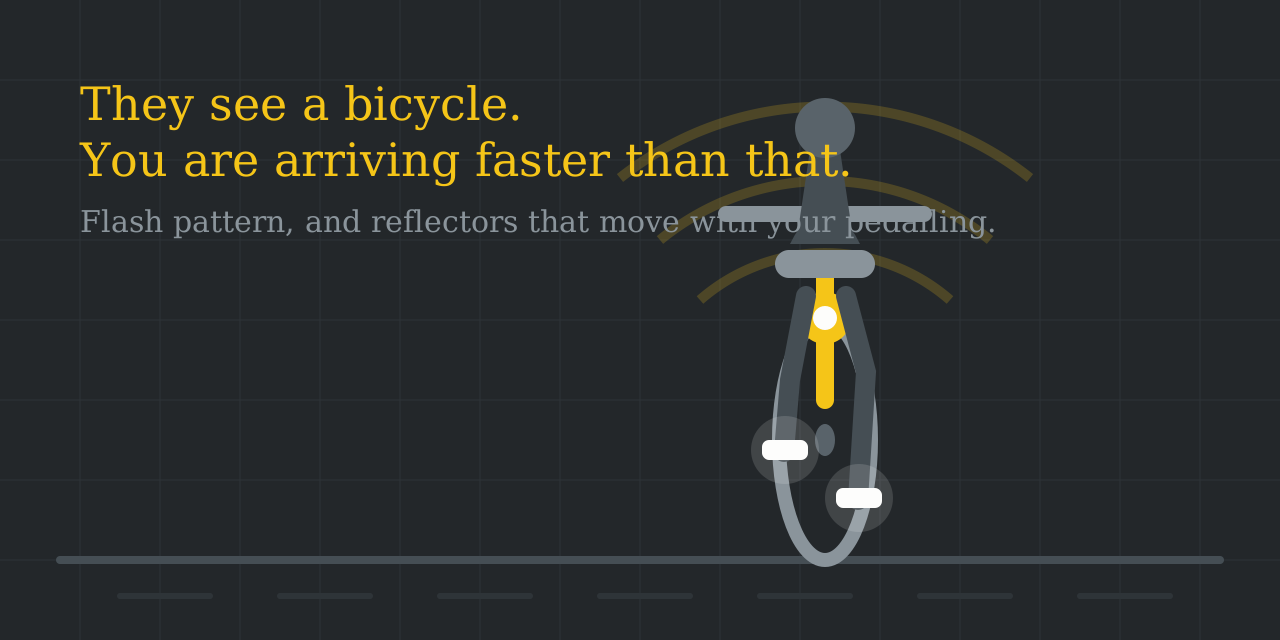
Buy a rear light with a real daytime flash mode first, and reflective ankle bands second. Together they cost around $50, and they cover the two things the research is clearest about: a distinct flash pattern is what pulls a driver's attention to you from behind, and reflective material that moves with your pedalling is what makes them recognise you as a person rather than a stray light.
This is not only a night problem. Flash modes exist because a steady light disappears into a road already full of car daytime running lights. The riskiest light of the year is not midnight, it is the twilight your commute now ends in, when the sky is still bright, drivers' headlights are not on yet, and low sun is in somebody's eyes.
The e-bike-specific part is speed, not darkness. A driver judging whether they can pull out sees a bicycle and estimates a bicycle's closing speed. On a Class 3 e-bike you can be arriving 10 to 15 mph faster than that estimate, into a gap that was calculated correctly for the wrong vehicle. Misjudged approach speed is a documented factor in car-versus-motorcycle collisions for exactly this reason, and it is the part more lumens do not fix.
And the cheap thing beats the expensive thing. A body of driving research keeps finding that a high-vis vest does far less than riders expect after dark, while reflective strips on the ankles and knees do a great deal. The ankle bands are the least impressive purchase on this page and probably the highest-value one.

The deadline is September, not November
Daylight saving time ends on Sunday 2026-11-01, and that is the date everyone plans around. It is the wrong date. The clock change is only the last step of something that has been happening since August: across the northern half of the country, sunset walks roughly an hour and a half earlier between the start of September and the end of October. A 5:30 pm ride home is fully lit in August, finishing in twilight by late September, and finishing in the dark before Halloween. The November change just removes the last hour in one go.
So the useful trigger is not the clock change. It is the first evening you notice you are riding home in dusk, which for most commuters lands in the second half of September.
Dusk is the harder problem, not the easier one. In full darkness the situation is at least simple: your lights are the brightest thing in their lane and headlights are illuminating your reflectors. In twilight nothing is true yet. The sky is still bright enough to wash out a modest tail light, a lot of drivers have not switched their headlights on, so your reflectors are doing nothing, and a low sun sits directly in the eyes of anyone travelling toward it. Gear that only works after dark is gear that misses the worst hour of the day.
What the conspicuity research actually supports
There is a real literature on whether drivers see cyclists, and it is more useful than any product spec. Three findings from it shape everything below.
High-visibility clothing does less than it feels like it does, especially at night. The Lighting Research Group at the University of Sheffield summarises the position bluntly: fluorescent and reflective clothing such as a hi-vis jacket is not very good at increasing a cyclist's conspicuity to drivers, particularly after dark (Wood et al. 2010; Rogé et al. 2019). Fluorescent fabric needs daylight to fluoresce, and a large reflective panel on your back reads as a bright shape, not as a human being.
Reflectors on moving joints do a great deal. The same review finds that bio-marking, meaning reflectors on the wrists and ankles, greatly improves conspicuity (Costa et al. 2017; Edewaard et al. 2017 and 2020; Wood et al. 2010 and 2012). The mechanism is the interesting bit: your ankles trace a rhythmic circle when you pedal, and human vision is unusually good at recognising that pattern as a person. Drivers do not just see you sooner, they identify what you are sooner, which is what changes their behaviour.
Riders systematically overestimate how visible they are. Wood et al. 2013 found cyclists think they are more conspicuous than they measurably are, which may be why people skip precautions. Read that as a warning about your own judgement rather than about anyone else's.
Two honest caveats before you spend anything. Most of this work studies conventional bicycles and pedestrians in driving simulators or on closed roads, not e-bikes in traffic, and EbikeTested has run none of it. And the Sheffield group flags a specific gap: bio-marking studies have all used passive reflective strips, not active lights, and while they expect powered ankle lights to do better, nobody has tested it. So an LED ankle band is a reasonable extrapolation from good evidence, not a proven upgrade. Reflective bands are the version the research actually supports.
The second-headlight question, answered honestly
A common upgrade among riders who think hard about this is a second front light mounted beside the first, on the theory that two separated lights give a driver something to judge distance and closing speed against, the way two headlights on a car do. It is a genuinely good instinct and it comes from a real place: the motorcycle safety world has worried about misjudged approach speed for decades, and researchers have tested exactly this, adding lights to make a triangle rather than a single point.
The results are more mixed than the theory. In the published work on front light configuration, three lamps in a triangular pattern were proposed to help drivers estimate speed and distance, but a triangular design using two extra lights on the handlebars produced no significant improvement in detection. What did significantly improve conspicuity in those tests was additional yellow lights placed on the rider's helmet and on the fork (Accident Analysis & Prevention, 2014, and the related work on innovative headlight configurations).
The practical reading is that separation helps most when it is vertical and attached to the human. Two lights side by side on your bar are still one horizontal line at bar height. A light on your helmet is a metre higher, moves when you look, and sits where drivers scan for faces.
There is a second finding worth carrying: researchers have shown that car daytime running lights create visual noise that competes with a motorcycle's lighting. Every new car on the road now runs bright white DRLs. Adding one more steady white light to that scene does not distinguish you from it. A distinct flash pattern does, and biomotion does, because no car has ankles.
So if you want more front presence: add a helmet light before a second bar light, and prefer a light with a genuine daytime flash over a brighter steady beam.
What to add, in the order that buys the most per dollar
| Buy this | Why it sits here | Roughly |
|---|---|---|
| A rear light with a daytime flash mode — Magicshine SEEMEE 200 V3.0 | On a commute the danger is overwhelmingly behind you, and a day flash covers the dusk hour that a night-only light misses. | $35–50 |
| Reflective ankle bands — Leg Shield bands | The biomotion effect. Cheapest item here, strongest research behind it, and it works on whatever you are already wearing. | $12–20 |
| A front light with a day flash, separate from the bike's own — NiteRider Lumina 1200 Boost | Integrated headlights are aimed to help you see and rarely flash at all. This is the "be seen" layer, and it survives a flat main battery. | $60–110 |
| A mirror — Hafny HF-MR095 | Cheap situational awareness. Lets you see the car your tail light is talking to, and whether it has moved over. | $25–40 |
| Rear-facing radar with a tail light — Garmin Varia RTL515 | The only item that tells you a car is closing before you can hear it. Expensive, and the one people who ride dark roads keep saying they would rebuy. | ~$200 list |
| A horn a driver can hear — ROCKBROS 120dB | Bells are for shared paths. A closed car with the radio on is a different problem and needs a different noise. | $15–25 |
What your e-bike's built-in lights do, and do not do
Integrated lights are one of the genuine advantages of an e-bike: they run off the main pack, so they are always charged and you never think about them. That advantage hides three gaps.
- They almost never have a daytime flash. Integrated rear lights are usually steady-only, and steady is the mode the research says gets lost against traffic.
- They die with the bike. Turn the system off, or pull the pack to charge it indoors over winter, and you have no lights at all. If you store the battery in the house from November, your bike is unlit in the garage on the morning you are running late.
- The front one is aimed at the road, not at drivers. A fork-crown or lower-fork headlight is mounted low and pointed down so you can see the surface. That is the correct job for it, and it is not the same job as being noticed from an intersection.
None of that is a reason to replace them. It is a reason to treat them as your "see the road" layer and add independent, separately powered lights as your "be seen" layer. Two power sources also means a mismanaged charge cycle never turns into a dark ride home, which is worth reading alongside our replacement charger and battery guide if your pack is aging.
Lighting law is state law and it is a floor, not a plan. The common statutory pattern is a white front lamp visible from around 500 feet plus a red rear reflector visible from around 600 feet, with many states also requiring or accepting a rear lamp, and some setting extra equipment rules by e-bike class. Whether a flashing lamp satisfies the front-light requirement varies by state. Two things worth internalising: a reflector only works when a headlight is already pointed at it, so it does nothing in twilight, and meeting the legal minimum has never been the same as being seen.
The picks
Chosen on published specifications, manufacturer claims and the configuration research above, not on a road test. EbikeTested has not run a night visibility trial, and when we do it will be a measured one. Weights and dimensions marked as listed come from Amazon's own product data. Prices are approximate street ranges as of mid-August 2026, they were not re-checked against live listings the day this went out, and they move constantly.
Buy this firstMagicshine SEEMEE 200 V3.0
A rear light with output high enough to register in daylight, a 360-degree lens so you are visible from the side at junctions, and a brake sensor that flares the light when you slow. Listed at about 0.09 lb and roughly 7 cm long, which is the spec that matters most: it is small enough that it lives on the bike permanently instead of in a drawer. If the risk on your route comes from behind, and on a commute it does, this is the highest-value light you own.
Check price on Amazon Best value on the page
Leg Shield reflective ankle bands
Plain reflective bands with a large reflective area, sold on a claimed visibility of over 1,000 feet. The reason they are here is not the maker's number, it is that ankles are where the conspicuity research keeps finding the effect: reflectors on moving joints let a driver recognise a person, not just a light. This is the item most riders skip and the one with the best evidence behind it. Wear them over whatever you already have on.
Check price on Amazon Front light
NiteRider Lumina 1200 Boost
NiteRider builds a daylight-visible flash into this line specifically because cars now run daytime running lights, which is the same reasoning the motorcycle research arrives at. A 1,200-lumen ceiling is more than a lit street needs and the reason to have it is unlit sections and the flash mode, not raw brightness. Runtime falls sharply at the top setting on any light in this class, so plan your commute around the middle modes.
Check price on Amazon Most underrated
Hafny HF-MR095 handlebar mirror
Glass rather than acrylic, adjustable, and sold in handlebar and bar-end fittings, so check which one your grips allow before ordering. A mirror is not conspicuity gear at all, which is why it belongs here: everything else on this page is an attempt to influence a driver, and a mirror is the only item that tells you what the driver actually did. On winter roads where you may need to take a lane around debris, it is the difference between guessing and looking.
Check price on Amazon If the budget stretches
Garmin Varia RTL515
A tail light with a rear-facing radar that warns you about vehicles approaching from behind, quoted by Garmin at up to 153 yards, with alerts on a paired Edge computer, watch or phone. Listed at about 0.16 lb. It is the most expensive thing here and the hardest to justify on paper, and it is also the item that changes how a dark road feels, because it removes the part where you are guessing about the noise behind you. Worth it if you ride unlit roads without a shoulder; skip it for a lit urban commute where you already have a mirror.
Check price on Amazon Loud enough to matter
ROCKBROS 120dB electric horn
A rated 120 dB electronic horn on a strap mount, IPX4, listed at about 34 g. A bell is a courtesy device for shared paths and it does not carry into a closed car with the windows up. This does, and it doubles as the tool for a dog running at your wheel. Ration it: a horn used on every commute stops being information.
Check price on AmazonThe dog section, kept short
Dark rides and loose dogs overlap more than they should, mostly because early evening is when people let dogs out. Two things help and neither is dramatic.
The first is the horn above. A dog chasing a bike is usually chasing movement rather than you, and a loud, unfamiliar noise interrupts the chase more reliably than shouting does.
The second is a deterrent spray, and the honest framing is that it is a last resort you hope stays in the bag. Halt is the long-standing option, a 1.5 oz capsaicin aerosol accurate to roughly 10 feet that the US Postal Service has carried since the 1960s. Two caveats. Carrying and using animal deterrent sprays is regulated differently by state and sometimes by city, so check your own rules rather than assuming. And on an e-bike the motor genuinely is the best answer available: a dog that has committed to a chase usually gives up within a few hundred feet, and calmly riding out of its territory beats stopping to deal with it. Reach for the can only when leaving is not an option.
Common questions
Does a flashing light really help during the day?
The reasoning is sound and it is why manufacturers build the mode. Every modern car runs bright steady daytime running lights, and motorcycle research has specifically found that this creates visual noise which competes with a smaller vehicle's lighting. A steady light joins that background; an irregular flash does not look like anything else on the road. The caveat is that flash patterns make you harder to track precisely once a driver has found you, which is why most riders run flash on the rear and a steady beam plus flash on the front where they need to see. Some states also restrict flashing front lamps, so check before you rely on one to meet the legal requirement.
Should I mount a second headlight next to my first one?
Probably not, and this is the most common well-intentioned upgrade that the evidence does not back. Published tests of triangular front light configurations found that two extra lights on the handlebars did not significantly improve detection, while extra lights on the helmet and fork did. Two lights on the same bar are still one horizontal line at bar height. If you want a second light, put it on your helmet: it is higher, it moves where you look, and it is closer to where drivers scan.
Are the lights my e-bike came with enough?
For seeing the road, usually yes. For being seen, usually not, for three reasons: integrated lights are almost never able to flash, they are typically aimed low and forward for your benefit rather than a driver's, and they go dark when the main pack is off or removed. Keep them and add an independent rear flash and reflective ankle bands. That combination costs about $50 and covers the gaps.
What is the single cheapest thing that makes a real difference?
Reflective ankle bands, at around $15. The research on cyclist conspicuity repeatedly finds that reflective material on moving joints does far more than an equivalent amount on your torso, because the pedalling motion is what identifies you as a person. It is an unglamorous purchase and it outperforms a hi-vis jacket costing five times more.
So a hi-vis vest is useless?
Not useless, but weaker than it feels, and weakest exactly when you most want it. Fluorescent fabric works by reacting to ultraviolet light, so it helps in daylight and overcast conditions and does nothing after dark. A reflective panel on your back does work at night but only when headlights are already pointed at it, and it presents as a bright rectangle rather than a human shape. Wear it if you have it, then add the ankle bands, which are what the research is actually pointing at.
Do I need radar, or is that overkill?
It depends entirely on your road, not your budget. On a lit urban commute with a mirror, radar mostly tells you what you can already see and hear. On an unlit rural road with no shoulder and cars closing at 55 mph, it gives you several seconds of warning you cannot get any other way, and that is the situation where the price stops looking silly. Buy the tail light and the ankle bands first either way, since both help in every situation.
The short version
Spend the first $50 on a rear light with a daytime flash and a pair of reflective ankle bands, and add them before the end of September rather than after the clocks change. Add a front flash that does not depend on the bike's battery. If you want more presence up front, go up to a helmet rather than sideways along the bar. Get a mirror when you can, and radar only if your route genuinely justifies it.
The thread running through all of it is that being seen and being understood are different problems. Lumens solve the first. Flash patterns, biomotion and a realistic sense of how fast you are arriving solve the second, and the second is the one that gets riders hurt at intersections.
When the bike is parked and unlit at the other end of the ride, that is a different problem with a different answer: see best e-bike locks and best e-bike GPS trackers.