Best E-Bike Locks (2026): What to Buy for Your Actual Situation
Not a ranking. A decision: how much lock your bike and your parking spot justify, why two cheap-ish locks beat one expensive one, and the six picks that hold up once you know which problem you are solving.
Some links below are affiliate links. If you buy through them, EbikeTested may earn a commission at no extra cost to you. Commissions never touch a score, and the failures get published anyway. Full details on our affiliate disclosure page.
There is no single best e-bike lock, because the right answer depends on two things: what your bike is worth, and where it sits when you are not on it. A $900 commuter locked in a garage overnight and a $3,000 cargo bike parked on a city street all day are not the same purchase.
If you want one answer: the Hiplok D1000 is the most lock you can reasonably carry, verified Sold Secure Powered Cycle Diamond, and at a verified $329.99 it costs about a tenth of what it is protecting on most e-bikes. If that is more than you want to spend, the Kryptonite New York Fahgettaboudit Mini at a verified $146.79 is the long-standing sensible answer.
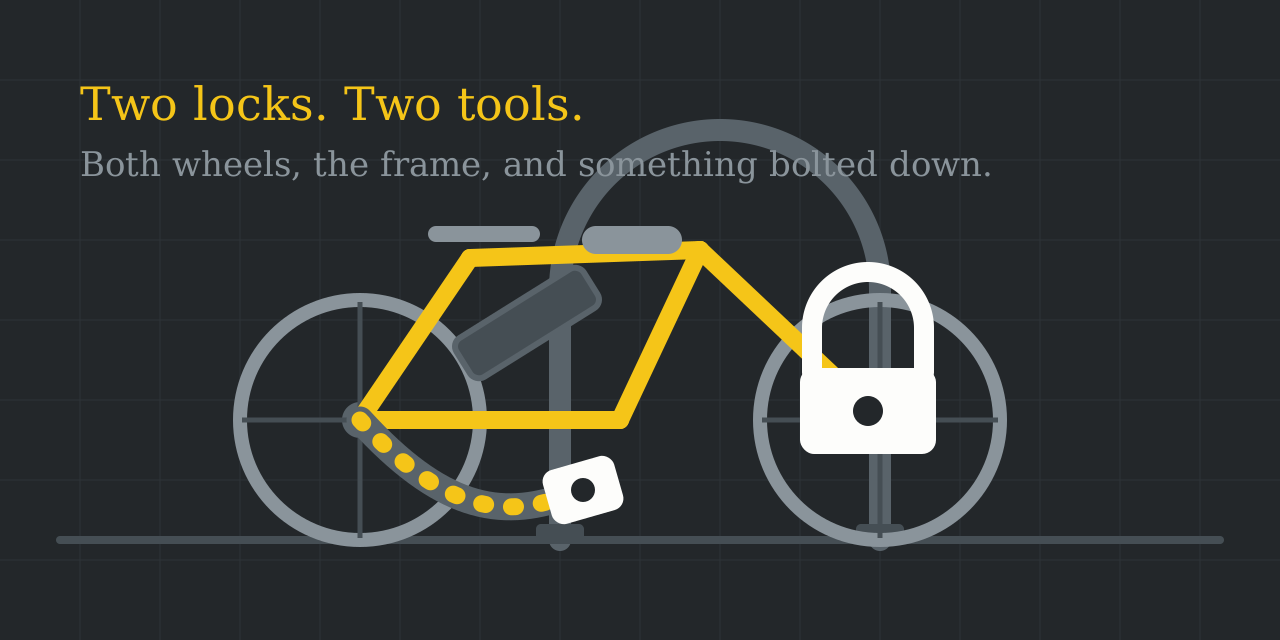
But the better answer is usually two locks. Two different lock types force a thief to bring two different tools, work for longer, and make more noise. Field advice across the security world converges on this hard: a bike wearing a D-lock and a chain is a bike that gets skipped. If your budget is $200, two $100 locks beat one $200 lock almost every time.
And the thing no lock fixes: what you lock to. A Diamond-rated lock around a signpost that lifts out of the ground is a Diamond-rated lock that goes home with the thief.
Certification questions — what Powered Cycle means, which tier is which — are answered separately in our Sold Secure explainer. This page is about what to buy.

What you are actually buying against
Lock buying went strange a few years ago, and the reason is the cordless angle grinder. It is cheap, it is battery powered, it fits in a backpack, and in the hands of someone who does not care who is watching it goes through most of what used to count as a serious lock in well under a minute.
That changed what a lock is for. No lock is grinder-proof. The good ones are grinder-*resistant*, which means they are built to eat discs, throw sparks, take multiple cuts, and take long enough that the person doing it starts thinking about who is filming. That is the actual product: time, noise, and attention.
So the useful question is not "will this stop a thief". It is "how much time does this buy, and is there an easier bike within sight?" Almost all bike theft is opportunistic, and opportunists compare. Everything below follows from that.
If you want the full picture of how e-bikes specifically get taken — including the ones that never involve cutting a lock at all — that is how e-bikes get stolen.
How much lock does your situation justify?
The usual rule of thumb is to spend roughly ten percent of the bike's value on the lock. It is a decent starting point and it is incomplete, because it ignores where the bike parks.
Run both numbers instead:
Bike value sets the floor. A $700 folding commuter does not justify a $330 lock. A $3,000 cargo bike does, and then some, because it is also the bike a thief will actively look for rather than stumble across.
Parking situation sets the multiplier. Ranked roughly by risk, from lowest to highest: inside a locked home; inside a locked garage or shared bike room; outside overnight at home; outside during the day in a busy public place; outside overnight in public. The last one is a genuinely different problem from the first, and the same bike can move between them during one week.
Time exposed matters more than most people think. Ten minutes outside a coffee shop in daylight is a different exposure from nine hours outside an office. Many people need two answers: a lock they carry for short stops, and a heavier lock that lives permanently at the place they park all day.
That last point is the one that saves the most money. A heavy chain you leave locked to the rack at work costs you nothing to carry and can be far more lock than you would ever haul on a ride.
Which lock for which situation
| Your situation | What to buy | Roughly |
|---|---|---|
| Bike lives indoors; short daytime stops only | A good mid-tier D-lock — Hiplok DX or Kryptonite New York | $60–110 |
| Under $1,500 bike, parked in public during the day | Kryptonite Fahgettaboudit Mini (verified $146.79), plus a cheap secondary | $150–200 |
| Over $2,000 bike, parked in public during the day | Hiplok D1000 (verified $329.99) or a Litelok X1/X3 | $200–330 |
| Parked outside overnight, any value | Two locks, different types — a grinder-resistant D-lock plus a hardened chain | $250–450 |
| Same rack every day (office, station, home) | Leave a heavy chain or ground anchor there permanently; carry a light D-lock | $120–250 once |
| You will not carry anything heavy, honestly | A wearable chain you will actually bring beats a Diamond lock left at home | $60–120 |
The two-lock strategy, and why it beats one expensive lock
This is the highest-value thing on this page and it is not a product.
A thief with a grinder has one tool and a plan for one kind of lock. Give them a D-lock and a chain, and the job changes shape: different cutting angles, different disc wear, a second setup, and roughly double the time out in the open. The consistent advice across security guidance and field testing is that two different lock types dramatically increase the time, noise and number of tools required, and that a bike wearing both is the one that gets passed over.
How to use them:
- Lock 1 (the D-lock): frame and rear wheel, to the stand. The rear wheel and frame are the expensive parts, and this is the anchor.
- Lock 2 (the chain): front wheel to the stand, or front wheel back through the frame if the stand will not reach.
- Fill the D-lock. A U-lock with a lot of empty air inside gives a thief room to insert a jack or a lever. Choose a size that is snug around what you are locking, which is why the very small "mini" U-locks are popular despite being awkward.
- Keep both locks off the ground. Concrete is a free workbench: it lets a thief brace the lock and put their whole body into a tool. Higher on the frame, lock facing down, is harder to work on.
Budget-wise this is why $200 is better spent as two $100 locks than as one $200 lock. One lock has one weakness and one solution. Two have neither.
The rules that matter more than which lock you buy
A better lock on a bad locking habit is money wasted. These are free:
Lock to something that cannot be defeated. Proper bolted-down cycle stands, not scaffolding, not a wooden fence, not a signpost the whole assembly can be lifted over. A signpost with nothing on top of it is a lift-and-go. This is the single most common way a good lock is beaten without ever being cut.
Lock the frame, not just a wheel. A lock through the front wheel alone leaves a quick-release wheel behind and the rest gone.
Both wheels, if you can. If you can only manage one, take the rear — it is the more expensive wheel and on most e-bikes it is the motor.
Park where people are. Lit, visible, overlooked, ideally covered by a camera. Grinder work is loud and conspicuous; the whole defence is social as much as mechanical.
Vary your parking spot if you can. A bike that is in the same place at the same time every day can be scouted, and a scouted bike gets taken with the right tool rather than whatever was handy.
Take the battery with you when it is practical. It is often a third of the bike's value, it is the part with the healthiest resale market, and a bike without one is a much less interesting object.
If you have e-bike insurance, check your policy before you buy anything on this page. Insurers frequently require a specific certification tier — and some require the lock be attached to an immovable object, or exclude overnight street parking entirely. A claim denied on a lock technicality costs far more than the lock did. We cover what policies actually ask for in e-bike insurance lock requirements.
The picks
Selected on certification status, makers' claimed specs, and how each one fits a real situation. EbikeTested has not yet run a timed destruction round on any of these — retail purchases for that are next, and the standards are in how we test. Prices marked verified were checked against live Amazon listings on 2026-08-03; everything else is an approximate street range and all of it moves.
Best overallHiplok D1000
Sold Secure Powered Cycle Diamond and Pedal Cycle Diamond, verified in the certifier's database. Hiplok claims 1.9 kg with a graphene-reinforced shackle and a square profile that forces two cuts rather than one. The reason it wins is not that it is the strongest object here — it is that it is light enough that people actually carry it, and the lock at home protects nothing.
Check price on Amazon Best value
Kryptonite New York Fahgettaboudit Mini
Powered Cycle Gold and Pedal Cycle Diamond, verified. An 18 mm hardened shackle and double deadbolt, claimed at 2.06 kg. It predates the grinder-composite era, so it is not in the same class as the Diamond locks against a grinder specifically — but it is heavily proven against everything else and it is less than half the price. The right pick for a sub-$1,500 bike, and a very good second lock for an expensive one.
Check price on AmazonLitelok X1
Powered Cycle Diamond, verified in the Sold Secure database, at a claimed 1.7 kg — the lightest lock on our verified Diamond list. Litelok's Barronium composite is designed to wear grinder discs out rather than resist them outright. Note that Litelok is a UK brand with limited direct US retail, so availability on Amazon varies; this is a search link rather than a fixed listing.
Check availability on AmazonLitelok X3
Powered Cycle Diamond plus ART 4, claimed at 2.1 kg with a longer shackle that reaches around fatter frames, wider tyres and awkward stands — a real constraint on cargo and fat-tyre e-bikes. Litelok claims at least 20 times the grinder resistance of leading D-locks; that is a maker's number and exactly what our timed round exists to check. Same US availability caveat as the X1.
Check availability on Amazon Heaviest duty
ABUS Granit Super Extreme 2500
A 27 mm shackle clad in a tungsten carbide shell, which is the material grinder discs are made to cut with — the intent being that the disc gives up before the cladding does. ABUS carries a Diamond badge but we could not confirm the Powered Cycle category specifically against the certifier's records, so treat the tier as unconfirmed. Heavy. This is a lock for a bike that stays put.
Check price on Amazon The leave-it-there lock
Kryptonite New York Fahgettaboudit Chain 1415
A 14 mm hardened manganese steel chain with the New York disc lock, carrying a Powered Cycle Gold rating in Sold Secure's database as a combination. Far too heavy to ride with, which is the point: leave it permanently wrapped around the rack you use every day and carry a light D-lock for everywhere else. This is the cheapest route to a genuine two-lock setup.
Check price on AmazonBuying an e-bike lock: FAQ
How much should I spend on an e-bike lock?
The common rule is around ten percent of the bike's value, and it is a reasonable floor. Adjust it up sharply if the bike parks outside in public, and especially if it parks outside overnight — that situation justifies more lock than the ten percent rule suggests. Adjust it down if the bike sleeps indoors and only ever stops briefly in daylight. If your budget lands over about $200, split it across two different lock types rather than buying one better lock.
Are any bike locks actually angle grinder proof?
No, and any product claiming otherwise is overselling. The best current locks are grinder-resistant: they use composites or carbide cladding to wear discs down, and shapes that force multiple cuts, so the attack takes several minutes rather than under one. That is a meaningful difference in the real world, because the defence is time, noise and exposure rather than invulnerability. Treat every "grinder proof" claim as marketing.
U-lock or chain for an e-bike?
A D-lock or U-lock if you are only carrying one, because it resists leverage far better and the good ones are lighter than an equivalent chain. A chain earns its place as a second lock or as a lock you leave permanently at a fixed parking spot, where its weight costs you nothing and its length reaches things a U-lock cannot. The strongest practical setup for most people is one of each.
Do I really need two locks?
If the bike parks in public for hours or overnight, yes, and it is the single highest-return decision on this page. Two different lock types mean two tools, two setups and roughly double the exposed working time for a thief, and the consistent field advice is that a bike wearing both gets skipped for an easier one. If the bike lives indoors and only stops briefly, one good lock is proportionate.
What is the best lock for a heavy cargo or fat-tyre e-bike?
Reach matters more than usual, because oversized tubing, wide tyres and long chainstays defeat a mini U-lock. A longer-shackle Diamond lock like the Litelok X3, or a chain that can go around the frame and a fixed stand, is the practical choice. It is also the category where a permanent lock at your regular parking spot makes the most sense, since these bikes are heavy enough that you were not going to carry much anyway.
Does a Sold Secure rating matter if I am in the US?
It is the most useful independent signal available, even though Sold Secure is a UK certifier, because there is no equivalent US-wide standard and the tests are genuinely destructive rather than self-reported. The one thing to check is the category: Powered Cycle is the e-bike-specific test and it is harder than the bicycle equivalent. Our Sold Secure explainer has the tier-by-tier breakdown and the verified lock list.
Where is the worst place to lock an e-bike?
Anything the lock can be lifted off — a signpost with an open top, a bollard without a ring, a railing that unbolts. That defeats the best lock made without touching it. After that: low to the ground, where concrete gives a thief something to brace against, and anywhere out of sight, where a grinder can run for as long as it needs to.
Where this page sits
This is the buying page. The certification behind the picks is set out in Sold Secure Powered Cycle, explained, which carries the full verified rating list and the caveats on what we could and could not confirm. The threat model is in how e-bikes get stolen, and the policy small print in e-bike insurance lock requirements. A lock is only half of a recovery plan, so the GPS tracker guide covers the other half.
Everything above is certification-record and specification research, not our own destruction testing. Retail purchases for a timed grinder round are the next thing on this site's bench list, and until those numbers exist we will keep saying so — standards at how we test.