E-Bike Hauling: Racks, Baskets, Trailers and Child Seats (2026)
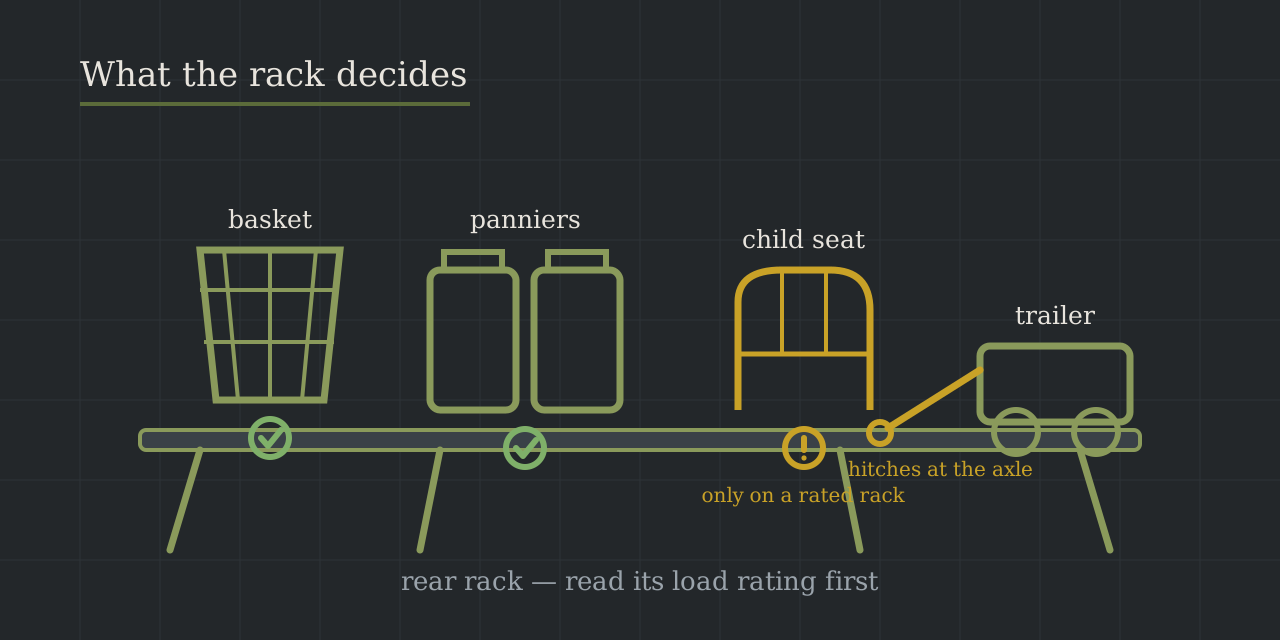
What you can bolt onto an e-bike is decided before you shop, by the mounts and the load rating you already have. That is why so many of these purchases arrive and do not fit, and it is the one thing a product roundup never tells you.
Some links below are affiliate links. If you buy through them, EbikeTested may earn a commission at no extra cost to you. Commissions never touch a score, and the failures get published anyway. Full details on our affiliate disclosure page.
Do not start with the product. Start with what is already bolted to the bike, because that is what decides your options and it is where almost every returned accessory goes wrong.
- A rear rack you already have opens up panniers, a rack-top basket and a rack-top bag. This is the cheapest and largest category, and it mostly just works
- No rear rack means the rack is your first purchase, and on an e-bike that usually means the manufacturer's own rack rather than a generic one, because the mounting points, the battery position and the wide tyres all interfere
- A child seat is not a rack accessory. It is a rack *rating* question, and many popular aftermarket racks explicitly forbid one. See the warning below before you buy anything
- A trailer bypasses the rack entirely. Most hitch at the rear axle or the seatpost, so the question is your dropouts, not your rack, and it is the only option that scales past about 55 lb
The number that governs almost all of this is the rack's load rating. A typical quality rear rack is rated around 25 kg (55 lb). That figure has to cover the accessory, the load and, if you are carrying a child, the child and the seat together. Read it off the rack or the manual before you shop, and if you cannot find it, treat that as a no.
Cheapest useful upgrade: a pair of panniers, if you already have a rack. Best value per dollar for actual capacity: a cargo trailer, which costs less than most cargo e-bike upgrades and carries far more.
We have not tested any of this gear. EbikeTested has no hauling bench. Every fitment statement below is the manufacturer's own, and every rating is quoted from a published specification, not measured by us.

The rule: what you can add is decided by what is already there
A regular bike is easy to accessorise because it is a standardised frame with standardised eyelets. E-bikes broke three of those assumptions at once, and the accessory industry has not fully caught up.
The battery is often where the rack wants to be. On a lot of commuter and folding e-bikes the pack sits on the rear rack or immediately under it, which means the rack is structural, proprietary, and already carrying a load before you add anything.
The tyres are wider. Fat-tyre bikes push the seatstays out, so a rack sized for a 26 to 29 inch conventional frame may not clear the tyre or may sit at a bad angle. This is also the most common reason a trailer hitch does not fit: the axle hardware is different.
The mounting points vary and the frames are heavier. Some e-bikes have no rack eyelets at all. Some have proprietary bosses that only take the manufacturer's rack. And the whole bike is heavy enough that a marginal fit that would be tolerable on a 25 lb bike is not tolerable at 70 lb with a load on the back.
So the sequence is always the same:
- Look at the bike and identify what is already fitted: a rear rack, a front rack, eyelets, nothing
- Find the load rating of whatever is fitted. It is printed on the rack, stamped on the strut, or in the manual
- Decide what you need to carry and what it weighs, including the accessory itself
- Only then choose a product, and check its stated compatibility against your actual bike
If your bike has no rear rack and you want one, look at the manufacturer's own accessory range first. It costs more than a generic rack and it is the one guaranteed to have been designed around your battery, your tyre width and your mounting points. Our what actually fits a Rad when the OEM part is sold out guide covers what to do when that range is unavailable, which on some brands it currently is.
Before you buy anything to carry a child: a rack rated for cargo is not automatically rated for a child seat, and several popular ones explicitly forbid it. Ibera, whose PakRak Touring Carrier Plus+ is one of the most recommended aftermarket racks on the market and is rated to 25 kg (55 lb), states in its own documentation: do not attach a child or baby seat to the carrier, and its carriers are not designed for carrying a child or an adult in any manner. A cargo rating and a child-seat approval are different claims, and only one of them is usually printed on the box. Separately, check your bike's manual for whether the manufacturer permits a passenger at all, since a number of e-bikes are explicitly rated for the rider only, and check your local rules on carrying a child on an e-bike, which differ by state and country. We are pointing at published manufacturer positions here; we are not a safety authority and nothing on this page is a substitute for the instructions that came with your bike and your seat.
What you can add, by what your bike already has
| What you want to carry | What it needs | What actually has to match | Rough capacity |
|---|---|---|---|
| Groceries, a bag, a jacket | Existing rear rack | Nothing much. Panniers clip to standard rack tubing | Up to the rack rating, usually ~55 lb |
| Bulky, awkward loads you want to see | Front basket or front rack | Handlebar clearance for cables and a display, or front rack eyelets | 10-20 lb, and it affects steering |
| A dog, camping kit, a big shop | Trailer | Axle or seatpost hitch fit, not the rack. Check the dropouts | 80-110 lb typical |
| A child, seated on the bike | A rack rated and approved for a child seat | Rack load rating (55 lb standard, 78 lb for the XL adapter), rack tube width, and the maker's explicit approval | Seat-dependent; commonly ~48 lb child |
| A child, towed behind | Child trailer | Axle hitch fit, and the trailer's own age and weight limits | One or two children per model |
| Nothing fits and the bike has no mounts | The manufacturer's own rack | Proprietary bosses, battery position, tyre width | Per the bike maker |
Baskets: front or rear, and the clearance nobody checks
Baskets are the cheapest thing on this page and the most likely to be bought twice.
Handlebar-mounted front baskets are the classic, and they mount with straps or brackets to the bar rather than to the frame. On an e-bike the thing to check before ordering is what else is already on the bar: a display, a throttle, brake lever clamps, a light, and a cable run for all of it. A wide basket bracket can foul any of them. Measure the clear bar space either side of the stem and compare it against the basket's bracket span.
Load carried on the handlebar steers the bike. Weight on the bar turns with the bar, which changes the handling much more than the same weight over the rear axle. This is fine for a bag of shopping and genuinely unpleasant for anything heavy, and it is worse on a heavier bike at higher assisted speeds. Treat 10 to 20 lb as the practical ceiling regardless of what the basket could physically hold.
Front-rack-mounted baskets are the better version of the same idea, because the load sits on the frame or the fork rather than the steering. If you have just fitted a front rack, buy a basket sized to the rack platform rather than a handlebar basket, and bolt it down.
Rear rack-top baskets are the least glamorous and the most useful: the weight sits low and behind you, it does not affect steering, and it does not eat the pannier mounting position if you choose one that sits on the rack top rather than clamping around the tubing.
The old Wald steel baskets remain the default recommendation in this category for a reason that has nothing to do with cleverness: they are steel, they bolt on, and they are cheap enough that buying the wrong size is not a disaster.
Panniers versus a basket, when you already have a rack
This is the most common fork in the road for anyone whose bike came with a rear rack, and the two are not really competing for the same job.
Panniers win on capacity, weather and balance. A pair of 20 to 30 litre bags carries far more than any basket that fits the same rack, splits the weight either side of the wheel, and the waterproof roll-top designs genuinely keep rain out. They also come off the bike as bags, which matters if you are locking up in a city.
Baskets win on the shape of a real errand. You can drop something in a basket without unclipping, unrolling and re-rolling anything, which sounds trivial until you have done it in a car park in the rain. For short local trips with irregular loads, an open basket gets used and a pannier gets left at home.
The mounting detail that decides it: panniers hang from the rack's side tubing, and a rack-top basket that clamps around that same tubing can block the pannier hooks. If you think you might want both eventually, buy a basket that sits on the rack platform and bolts down, not one that clamps the rails.
If you are only buying one and the bike is for commuting or shopping, buy panniers. If it is for short errands where you are stopping repeatedly, buy the basket.
Child seats: the fitment chain, stated honestly
This is the question where a wrong purchase matters most, and where the marketing is least clear. There are four links in the chain and all four have to hold.
1. Does your bike permit a passenger at all? Check the manual, not the forum. Some e-bikes are rated for the rider only, and some brands sell a specific passenger package because the standard bike is not set up for it.
2. Is there a rack, and what is it rated for? A rack-mounted seat puts the child, the seat and any dynamic load onto that rack. A rack-mounted Thule Yepp Maxi weighs about 8.4 lb on its own before the child. If your bike has no rear rack, that is the first purchase and it is the one where the manufacturer's own part is worth the money.
3. Is the rack approved for a child seat, specifically? This is the link people miss. A cargo rating is not a child-seat approval, and as the warning above sets out, some of the best-regarded aftermarket racks explicitly exclude child seats in their own documentation. If the rack's maker does not say a child seat is permitted, assume it is not.
4. Does the seat physically mount to that rack? Thule's rack-mounted Yepp Maxi fits racks with an EasyFit window built in, or racks fitted with the separate EasyFit Adapter. That adapter fits rack tubing 11 to 17 cm wide and requires a rack rated to at least 25 kg (55 lb); there is an XL version for racks rated to at least 35 kg (78 lb). Usefully for this audience, Thule states the adapter allows installation on e-bikes where the battery sits underneath the rear rack, which is exactly the layout that rules out a lot of generic hardware.
On sizing: the rack-mounted Yepp Maxi is specified for children from around 9 months to 6 years, up to about 48.5 lb. A four-year-old at 40 lb is inside that, but not by a wide margin, and a child who is close to the ceiling now will be past it within a year. If your child is already near the limit, price the trailer option before the seat option, because it will last longer.
The frame-mount alternative. Some seats mount to the seat tube rather than the rack, which sidesteps the rack rating question entirely but introduces its own: frame clearance, seat tube diameter and shape, and whether a battery or a folding hinge occupies that space. On e-bikes this is often the harder fit, not the easier one, so check before assuming it is the way around the problem.
Trailers: the hitch is the whole question
A trailer is the only option here that scales past the rack rating, and among owners who have one it is consistently described as the thing that changed what the bike is for. It is also the option most likely to arrive and not attach.
Hitch type is what you are actually buying. Most trailers use one of two systems: a hitch that clamps at the rear axle or the dropout, or one that clamps the seatpost. Axle hitches are more stable under load and are the standard for child trailers; seatpost hitches are simpler and more universal but put the pull point higher up.
What breaks the fit on an e-bike, in order of frequency: a thru-axle instead of a quick-release skewer, wide fat-tyre dropout spacing, a motor or torque arm occupying the dropout, and a full-length rear fender or a rack strut in the way of the arm. Any of these can be worked around with the right adapter, but you need to identify which one applies before ordering, not after.
Before you buy, do this: take the rear wheel skewer or axle out and look at what is there. Note whether it is a quick-release skewer, a bolt-on axle or a thru-axle, and note the diameter. Then check the trailer listing's hitch specification against that. It takes two minutes and it prevents the single most common return in this category.
Cargo trailers versus child trailers. A cargo trailer is an open or covered box on two wheels, typically rated around 88 to 110 lb, and it is by far the cheapest way to add real capacity to any bike. A child trailer is a different product with a harness, a roll structure, suspension and weather protection, and the good ones convert to a stroller. Do not carry a child in a cargo trailer.
The e-bike-specific caution: a loaded trailer changes braking distance and cornering substantially, and an e-bike is already heavy and gets to speed easily. The combination is where people get caught out. Load it, ride it somewhere quiet, and find out what it does before you tow it in traffic.
The hardware
Amazon links, correctly tagged. EbikeTested has not tested any of this gear. Every compatibility statement, capacity and rating below is the manufacturer's own, quoted rather than verified by us; weights and dimensions come from Amazon product data. Fitment is specific to your bike, so check each listing's stated compatibility against your actual frame, rack and axle before ordering, and check the price too, because it moves.
Start here if you have a rackROCKBROS 30L waterproof panniers, pair
Roll-top PVC bags with a three-point attachment, two movable buckles and 360-degree rotating brackets, which is what lets them fit rack tubing of varying diameters rather than one proprietary system. Sold as a pair, model 30140022. The single highest-value thing you can add to a rack you already own.
Check price on Amazon Cargo rack only, not for child seats
Ibera PakRak Touring Carrier Plus+, disc brake mount (IB-RA5)
Frame-mounted rather than eyelet-only, height adjustable for 26 to 29 inch frames, rated by Ibera to 25 kg (55 lb), listed at 1.7 lb. The disc-brake version is IB-RA5; the non-disc version is IB-RA4. Ibera explicitly states that a child or baby seat must not be attached to this carrier, so if a child seat is anywhere in your plan, this is the wrong rack and you should be looking at your bike maker's own.
Check price on Amazon The cheap classic
Wald 137 front basket, 15 x 10 x 4.75 in
Steel, weather resistant, mounts to the handlebar with the included hardware, and light enough at a listed 2.01 lb that it is not itself part of your load problem. Measure the clear bar space either side of your stem first, because an e-bike cockpit is crowded. The Wald 139 is the larger 18 x 13 x 6 in version if you are carrying boxes rather than bags.
Check price on Amazon Most capacity per dollar
Aosom heavy-duty cargo trailer, 16 in wheels
Rated by Aosom to 88 lb with a universal hitch and 16 in pneumatic wheels, folding for storage, model B71-020, listed at 26.5 lb. This is the option that changes what the bike can do, and it costs a fraction of a cargo e-bike. Check the hitch specification against your rear axle before ordering. A covered version with a removable cover is worth the small premium if anything you carry can get wet.
Check price on Amazon Only on an approved, rated rack
Thule Yepp Maxi EasyFit, rack mount
Rack-mounted child seat, model 12020211, listed at 8.4 lb, specified by Thule for roughly 9 months to 6 years and up to about 48.5 lb, with a five-point harness and a childproof buckle. It fits racks with an EasyFit window, or racks fitted with the EasyFit Adapter, which requires a rack rated to at least 25 kg (55 lb) and fits tubing 11 to 17 cm wide. Read the callout above before buying either.
Check price on Amazon The longer-lasting answer for kids
Burley Bee child trailer, 1 and 2 seat
The default recommendation in this category for years. Bike-only, one or two children, a one-click five-point harness, UV-protected tinted windows, a hammock-style seat, front and rear reflectors, push-button wheels and a compact fold. If your child is already close to a seat's weight ceiling, this outlasts the seat by years. The Honey Bee is the version that also converts to a stroller.
Check price on AmazonE-bike hauling: FAQ
How much weight can an e-bike rear rack carry?
Read the rating rather than guessing: it is printed on the rack, stamped on a strut, or in the bike manual. A good quality rear rack is commonly rated to 25 kg (55 lb), and some heavy-duty and e-bike-specific racks go higher. That figure has to cover everything you put on it, including the accessory itself: a rack-mounted child seat weighing around 8 lb plus a 40 lb child is already most of a 55 lb rating. If you cannot find a rating anywhere, treat that as a reason not to load it heavily.
Can I put a child seat on any e-bike rack?
No, and this is the most important thing on this page. A rack having a cargo weight rating is not the same as the manufacturer approving it for a child seat, and several well-regarded aftermarket racks state in their own documentation that a child or baby seat must not be attached. Separately, some e-bikes are rated for the rider only. Check three things before buying: whether your bike permits a passenger, whether the rack is approved for a child seat by the rack maker, and whether the seat physically mounts to that rack. Rules on carrying a child on an e-bike also vary by location.
What do I check before buying a bike trailer for an e-bike?
The hitch, and specifically your rear axle. Take a look at what is actually there: a quick-release skewer, a bolt-on axle or a thru-axle, and note the diameter. Most trailers hitch at the axle or dropout, some at the seatpost, and the common e-bike blockers are thru-axles, wide fat-tyre dropout spacing, a hub motor or torque arm occupying the dropout, and a fender or rack strut fouling the arm. Most are solvable with an adapter, but you want to know which one applies before ordering.
Basket or panniers, if I can only buy one?
Panniers, if the bike is for commuting or shopping: more capacity, weather protection, weight split evenly either side of the wheel, and they come off as bags. A basket, if the trips are short and you stop repeatedly, because an open basket takes a load without unclipping anything and therefore actually gets used. One mounting detail decides whether you can have both later: a rack-top basket that clamps around the rack rails can block pannier hooks, so choose one that bolts to the rack platform instead.
Will a front basket affect how the bike handles?
Yes, more than the same weight on the back. A handlebar-mounted basket carries its load on the steering, so it turns with the bar and changes the feel of the bike noticeably, and that effect is larger on a heavy e-bike at assisted speed. Treat roughly 10 to 20 lb as the practical ceiling whatever the basket could physically hold, and if you want to carry more up front, use a front rack that mounts to the fork or frame so the load is not on the steering.
My e-bike has no rear rack. What now?
Look at your bike manufacturer's own accessory range first. Generic racks are sized around conventional 26 to 29 inch frames and can foul a fat tyre, a rear battery or proprietary mounting bosses, and on a heavy bike a marginal fit is a worse idea than on a light one. The manufacturer's rack costs more and is the one designed around your battery position, tyre width and mounts. If that range is out of stock, which on some brands it currently is, our guide to what fits a Rad when the OEM part is sold out covers how to reason about substitutions.
Where this page sits
EbikeTested buys its own gear and publishes failures, and our labs are still spinning up. Nothing here is an instrumented result: it is manufacturer fitment documentation and published ratings, labelled as what they are, plus the reasoning about why e-bike geometry breaks generic accessory fit. If you are adding hardware because the OEM part is unavailable, what actually fits a Rad covers the substitution logic part by part. If you are about to start leaving a loaded bike outside shops more often, how e-bikes actually get stolen and our lock buying guide are the other half of carrying things on a bike. Our standards are set out in how we test.