Best E-Bike GPS Trackers (2026): What Actually Survives a Theft
Trackers do not prevent theft. They convert it into a recovery chance, and only some of them survive contact with a thief who owns a phone. The two categories, what each one really costs, and the 2026 change nobody selling you a tag mentions.
Some links below are affiliate links. If you buy through them, EbikeTested may earn a commission at no extra cost to you. Commissions never touch a score, and the failures get published anyway. Full details on our affiliate disclosure page.
There are two kinds of bike tracker and they fail in opposite ways.
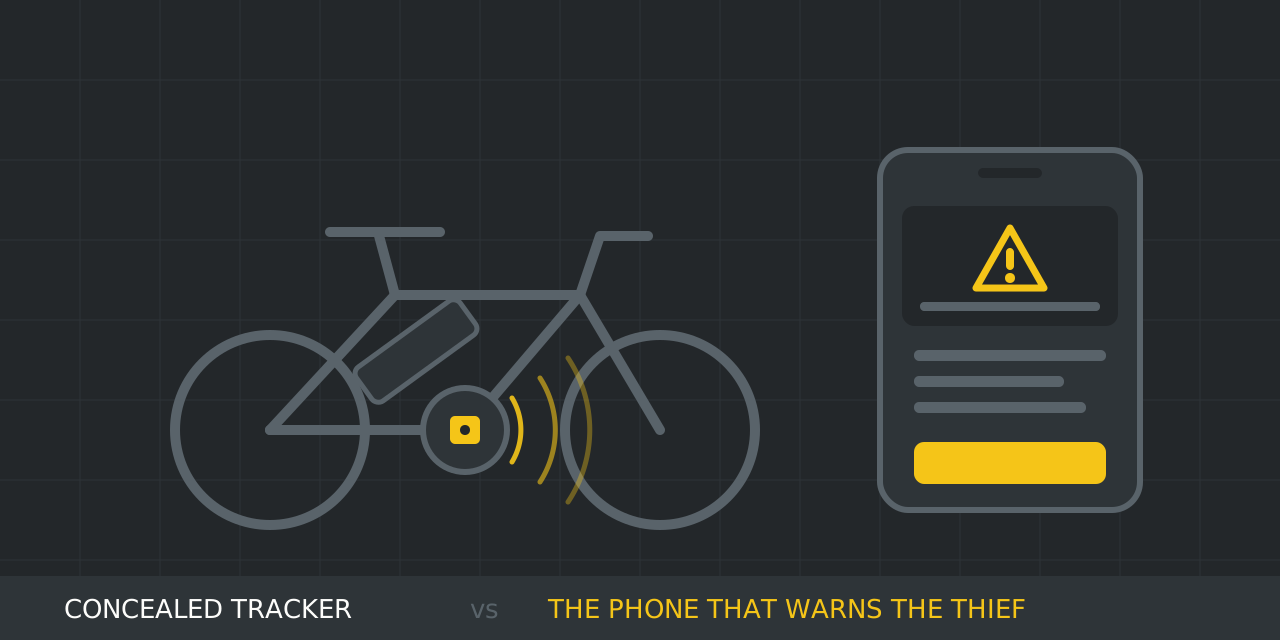
Crowd-network tags (an AirTag, a Knog Scout) are cheap, have no subscription, and report a position only when someone else's phone walks past them. They also announce themselves: since 2023 Apple and Google have shipped a joint unwanted-tracker standard, live on iOS 17.5 and Android 6.0 and up, so a thief carrying almost any modern phone can get a "tracker traveling with you" notification and then find the thing. That is the single most important fact about this category and it is missing from most listings.
Cellular GPS units (Invoxia GPS PRO, Tracki, PowUnity BikeTrax) report continuously over a mobile network, do not depend on passing strangers, and do not trigger anti-stalking alerts. They cost more, they need a subscription, and they need charging or a wired motor connection.
Our read, by what you own:
- Mid-drive e-bike (Bosch, Shimano, Yamaha, Brose, Giant) — a motor-integrated cellular unit is the best-concealed option that exists, and PowUnity's BikeTrax is the one that does it. It is not sold on Amazon in the US; buy it from PowUnity or a US dealer, and see the note below about why we are not linking it through a program.
- Hub-drive e-bike, or any regular bike — a self-contained cellular tracker hidden in the frame. It fits anything, and it is the only category that keeps reporting from an empty warehouse at 3am.
- Any bike, on a budget — a tag in a bolted, concealed mount beats nothing, as long as you understand it is a lottery ticket rather than a plan.
Buy the tracker as the last layer, after a Sold Secure Powered Cycle rated lock, not instead of one.
This article is sourced research, not our test data. EbikeTested's Security Lab has not yet run a tracker through a concealment-and-detection round, and until it has, everything below is manufacturer claims, published reporting, and documented platform behaviour, labeled as such.
What a tracker is actually for
Updated August 2026: expanded with three-year running costs, a fitment section covering what actually mounts on which frame, what quoted battery life really means, and what to do in the hours after a theft. The PowUnity link policy also changed — see the end of the page.
Start with the honest job description, because the marketing blurs it.
A tracker does not stop a theft. It does not slow one down. Every second of the actual crime happens exactly as it would have without one. What a tracker changes is what happens in the hours afterward: instead of a police report with no location, you have a police report with a location.
That is worth money, but it is worth money in a specific and limited way, and the numbers around recovery are worth knowing before you spend. In Bike Index's 2023 survey of theft victims, only 37 percent reported the theft to police at all, and police were involved in 63 percent of the recoveries that did happen. The commonly quoted figure for bikes returned to their owners overall sits around 5 percent. You will find vendor pages claiming trackers push recovery into the 25 to 40 percent range; we have not found a credible independent study behind those numbers and we are not going to repeat them as fact. What the evidence does support is narrower and still useful: recovery is mostly a police-involvement problem, and a tracker is the thing that gives police something to act on.
So the frame for this whole page: a tracker is the last layer, bought after the lock and after the free registration. We laid out the full stack in how e-bikes actually get stolen.
The 2026 problem with putting an AirTag on your bike
This is the part that changes the buying advice, and it is the part almost nobody selling a bike tag mentions.
Apple and Google jointly published a standard called Detecting Unwanted Location Trackers, built to stop Bluetooth tags being used to stalk people. It works exactly as designed: when a compatible tag is separated from its owner and stays near a stranger for a while, that stranger's phone tells them. Apple shipped it in iOS 17.5, Google in Android 6.0 and later, and the cross-platform version landed in 2024. A separated tag can also start emitting a sound on its own.
Now apply that to a stolen bike. The tag is separated from you. It is traveling with the thief. The thief is a stranger to it. If they are carrying an iPhone or a reasonably current Android, the platform is designed to warn them that an unknown tracker is moving with them, and to help them locate it.
That does not make crowd-network tags worthless. It does mean you should stop thinking of one as a covert device. Its realistic value is in the first minutes and hours, before an alert fires or gets noticed, and in the fraction of thefts committed by someone not carrying a phone that is set up to warn them. It is a lottery ticket that costs $30, not a recovery system.
Cellular GPS trackers are not part of that standard, because they are not Bluetooth tags reporting through other people's phones. They report over a mobile network on their own. No unwanted-tracker notification fires for them. That is the strongest argument for spending the extra money, and it is a structural advantage rather than a spec-sheet one.
The two categories, side by side
| What matters | Crowd-network tag | Cellular GPS tracker |
|---|---|---|
| How it reports position | Only when a stranger's phone passes nearby | Continuously, over a mobile network |
| Works in an empty industrial yard at 3am | Usually not | Yes, with signal |
| Warns the thief | Yes — covered by the Apple/Google unwanted-tracker standard | No — not a Bluetooth tag, so no alert fires |
| Ongoing cost | None | Subscription, roughly $40 to $50 a year |
| Power | Coin cell or USB-C, months between charges | Rechargeable, or wired into the e-bike battery on motor-integrated units |
| Concealment | Seat tube, bottle cage, under a reflector | Same, plus inside the motor housing on compatible mid-drives |
| Typical price | $30 to $70 | $150 to $250 plus subscription |
The three-year cost, actually added up
Every comparison of this category quotes hardware prices, which is the least useful number available. Subscriptions are what separate these products, and they only show up if you look past year one.
The table below uses published price bands and stated subscription rates as of mid-2026. They are claims and bands, not our measurements, and every one of them will drift — the point is the shape, not the decimals.
What each option costs to own for three years
| Option | Hardware | Ongoing | Rough 3-year total | What the money buys |
|---|---|---|---|---|
| Apple AirTag + bolted mount | ~$30 + ~$20 mount | None | ~$50 | A position lottery ticket that warns the thief |
| Knog Scout | ~$60 | None | ~$60 | Same lottery, plus an 85 dB alarm at the moment of theft |
| Tracki Mini | Low, sold bundled with service | Subscription, bundle-dependent — check the renewal rate | Bundle price plus renewals | Real cellular reporting at the lowest entry price |
| Invoxia GPS PRO | ~$130 range | ~$50/yr | ~$280 | Cellular reporting, months of battery, fits any bike |
| PowUnity BikeTrax | ~$200+ with first year of service | $3.95/mo after year one, per PowUnity | ~$295 | Concealment inside the motor and a tracker that cannot go flat |
Reading that table honestly
Three things fall out of it, and they are the buying advice.
The gap between a tag and real cellular tracking is about $230 over three years, not $100. That is roughly $6 a month. Against a bike worth $1,500 to $5,000 it is trivial; against a $600 commuter it is a meaningful fraction of the bike, and a tag plus a better lock is the better allocation of the same money. This is the one place where the honest answer genuinely depends on what you own.
The two cellular options land within about $15 of each other over three years despite very different hardware prices, because BikeTrax bundles the first year and charges less per month afterwards. So the choice between them is not financial. It is fitment: BikeTrax if your motor takes it, Invoxia if it does not.
Subscription-bundled hardware is the trap to read carefully. A tracker sold cheaply with a year of service attached is priced on the renewal, not on the box. Find the renewal rate before you buy, and check whether cancelling ends the tracking entirely — for cellular units it always does, because you are paying for the SIM.
The cellular options worth researching
PowUnity BikeTrax. The one built for e-bikes rather than adapted to them. It installs inside the motor area of compatible mid-drive systems, draws power from the bike's own battery, and reports position over cellular at short intervals. PowUnity claims compatibility across the large majority of e-bike brands, covering Bosch, Shimano, Yamaha, Brose and Giant systems. Two things make it the strongest pick for the bikes it fits: it is genuinely hidden, in a place a thief has to dismantle the drivetrain to reach, and being wired to the main battery removes the most common tracker failure, which is a dead tracker battery. PowUnity states the first year of app service is included with the hardware, with renewal after that at $3.95 a month billed monthly. Two limits: if your e-bike is a hub-drive, which most sub-$1,500 bikes are, this is not your product — and it is not carried on Amazon in the US. Buy it from PowUnity directly or from a US dealer that stocks it.
Invoxia GPS PRO. The general-purpose cellular tracker that keeps appearing in bike comparisons. It runs on 4G LTE-M, Invoxia lists up to three months of battery life at its standard reporting cadence, and the subscription sits around $50 a year. It fits any bike because it is not integrated with anything, which is also the trade: you are hiding a self-contained box somewhere on the frame rather than inside the motor. Reviewers repeatedly flag that it is not fully water-resistant, which matters a great deal on a bike that lives outdoors. If you buy one, plan the mounting location around weather, not just concealment.
Tracki Mini. The cheap universal option, and the one to understand carefully before buying. The hardware is small and inexpensive; the subscription is mandatory and it is where the real cost lives. Tracki lists 4G LTE with roughly one-minute automatic updates, and battery life of up to five days in real-time mode or up to 60 days in battery-saver mode — the same device, two settings, and that gap is the whole story of this category (more on it below). It is sold in hardware-plus-subscription bundles of six months, one year and two years, so price the bundle and then check what the renewal rate is, because the sticker on the tracker is not the cost of owning one.
A note on subscriptions. The recurring fee is the honest cost of the category and it is the reason people talk themselves into a tag instead. It is also why the three-year table below is the most useful thing on this page: a $30 tag and a $130 tracker are not $100 apart once you own them for a while.
The tag options, bought with clear eyes
Knog Scout. The best-designed thing in the cheap tier. It bolts under a bottle cage, runs on Apple Find My, charges by USB-C rather than eating coin cells, and adds an 85 dB motion alarm that a bare tag does not have. The alarm is the real feature: noise at the moment of the theft is a deterrent in a way that a silent position report never is. It needs an iPhone in your household to set up and use, and it inherits every limitation of crowd-network tracking, the unwanted-tracker alert included.
Apple AirTag in a bolted concealed mount. The cheapest entry, and the one with the largest crowd network behind it in most cities. The mount is not optional and it is not a nicety — a tag taped under a saddle is found in the first thirty seconds. Elevation Lab's TagVault Bike is the common answer: a sealed composite shell that bolts under a bottle cage with security screws and a driver in the box, rated IP68 by the maker. Anything that fastens with a strap or a zip tie is decoration.
The AirTag has no alarm and no cellular link, so it is purely a position lottery. Worth $30 as an extra layer; not worth treating as your recovery plan.
What both share. They are useful in dense areas with a lot of foot traffic and much weaker in rural or industrial settings, which is unfortunately where stolen bikes tend to end up. If your realistic theft scenario is a bike disappearing into a van, a tag's position history may end at the curb.
Where to hide it, and why the answer keeps getting worse
The standard concealment spots are the ones every guide lists: inside the seat tube or seat post, behind the rear reflector or light, inside a bottle cage with a purpose-made mount, and inside handlebar tubing for the smallest tags. On a mid-drive, the motor housing beats all of them.
The uncomfortable part is that these lists are public, and organised thieves read them. The recurring warning in recovery write-ups is that professionals know the common hiding places and will sweep a bike for a tracker before moving it far. Anything that survives that sweep does so because it is either genuinely inside a sealed part of the bike, or fastened with hardware that is slow to remove.
Three principles that hold up regardless of which unit you buy:
- Inside beats under. A tracker inside a sealed tube or a motor housing requires tools and time. A tracker cable-tied beneath a saddle requires a hand.
- Use tamper-resistant fixings if the mount offers them. Several bike-specific mounts ship with security bolts precisely because visible fasteners are an invitation.
- Charge it, or wire it. The most-cited tracker failure is not detection, it is a flat battery on the day it mattered. A calendar reminder is part of owning one; a motor-wired unit removes the problem entirely.
And the one that matters most: do not go and get the bike yourself. Every police force and every recovery service says the same thing, and the reason is obvious. Share the location with police and let them act on it.
Fitment: what will actually mount on your bike
This is the section most tracker guides skip, and it is the one that decides whether the thing you bought is usable. Work down to your own case.
Mid-drive e-bike (Bosch, Shimano, Yamaha, Brose, Giant). You have the option nobody else has: a unit that lives inside the motor area, wired to the main battery. Nothing else on this page is concealed to that standard, and nothing else is immune to a flat tracker battery. This is the reason to buy BikeTrax despite the direct-purchase friction. Fitment is motor-specific — you select your drive system when ordering, so check yours before assuming.
Hub-drive e-bike with bottle-cage bosses. The bottle cage is the standard hiding place and there are purpose-made mounts that bolt beneath it with security screws. It works, with one caveat worth stating plainly: it is also the first place an informed thief looks, which is why the mount matters more than the tracker.
The downtube trap, which is specific to e-bikes. General bike-tracker advice tells you to hide a tracker inside the downtube. On most e-bikes the downtube is full of battery. That advice does not transfer, and it is a common source of returns — check what is actually inside your frame before you plan around it.
Step-through, folding and many cargo frames. Frequently no bottle bosses at all, and often no usable seat tube either. Realistic options are inside the rear light housing, inside a rack tube, or inside a permanently-mounted frame or saddle bag. A bag is weaker concealment than it sounds — bags get taken with the bike but they also get discarded at the first stop.
Seat tube or seat post plug. Needs a round seat tube of adequate internal diameter, and it is ruled out by internal cable routing, a dropper post, or an in-tube battery. Measure before you buy a plug-style mount.
Fat-tire and cargo bikes. The best case for a self-contained cellular unit, because there is genuinely more bike to hide it in: battery boxes, rack tubing, cargo decks and running-board cavities all take a tracker without any of it being visible. If you own one of these, the size of the tracker is not a constraint, so buy on battery life instead.
Any bike, one universal rule: if the mount fastens with a strap, a zip tie or adhesive, assume it comes off in under a minute. Bolted, sealed, and inside something is the standard.
Trackers worth researching
Categories and models our research keeps surfacing, chosen for documented mechanisms rather than our own testing. Nothing here has been through the Security Lab yet. Every link below goes to a real product listing; prices move constantly, so treat the bands as bands. PowUnity BikeTrax is deliberately absent from this list because it is not sold on Amazon in the US — it is covered in the body with a direct, unpaid link.
 Best cellular for any bike
Invoxia GPS PRO tracker
Self-contained 4G LTE-M tracking with a maker-stated battery life up to three months at standard reporting, and no dependence on passing phones. Fits hub-drive e-bikes and regular bikes that a motor-integrated unit cannot. Reviewers consistently flag limited water resistance, so mount it somewhere dry as well as hidden.
See on Amazon Cheapest way into cellular
Tracki Mini 4G tracker
Small 4G LTE unit with roughly one-minute auto updates; Tracki lists up to 5 days in real-time mode and up to 60 days in battery-saver. Sold in bundles with 6-month, 1-year and 2-year service. Check the renewal rate before you buy, because the subscription is the actual price of this one.
See on Amazon Best cheap layer
Knog Scout
Bottle-cage mount, Apple Find My, USB-C charging, and an 85 dB motion alarm — the noise is the part a bare tag cannot match. Crowd-network limits and unwanted-tracker alerts still apply. Needs an iPhone.
See on Amazon Cheapest entry
Apple AirTag
The largest crowd network in most cities, in the smallest package. No alarm, no cellular, and covered by the unwanted-tracker standard — a $30 lottery ticket, not a plan. Do not buy it without the mount below.
See on Amazon Buy this with the AirTag
Elevation Lab TagVault Bike mount
Sealed composite shell that bolts under a bottle cage with security screws and the driver included, IP68 per the maker. This is the difference between a hidden tracker and a tracker that gets binned at the curb.
See on AmazonQuoted battery life is a setting, not a spec
Cellular trackers advertise battery life in months. They also, in the same listing, advertise real-time tracking. Both are true and they are not true at once, and the gap between them is the thing to understand before the day you need it.
Tracki is unusually transparent about this and its own numbers make the point: up to five days in real-time mode, up to 60 days in battery-saver mode — one device, one battery, a twelve-fold difference determined entirely by how often it reports. Invoxia's stated figure of up to three months is likewise a standard-cadence number, not a live-tracking one.
The reason is simple. A cellular radio waking up, acquiring a fix and transmitting is by far the largest power draw in the device. Report every few hours and the battery lasts a season; report every minute and it lasts days.
Three practical consequences:
- The months-long figure describes the tracker sitting in your hallway, not chasing your stolen bike. Once you switch to live tracking after a theft, plan in days.
- A tracker at 10 percent charge when the bike goes is a tracker that dies mid-pursuit. This is the single most-reported tracker failure and it is entirely preventable.
- Wired installs sidestep the whole problem, which is a large part of why motor-integrated units are worth their price on the bikes that take them.
If your unit is battery-powered, put a recurring calendar reminder in at half the quoted battery life and treat it as maintenance, the same way you treat tyre pressure.
What actually happens after the theft
The moment the tracker earns its money is also the moment most owners have no plan. Here is the order that works, and it is worth reading before you need it rather than after.
1. Report it to police and get a case number. Do this first, before anything else, and do it even though it feels futile. A location with no report attached is not something police can act on, and the recovery data says this is the step that matters most: Bike Index's 2023 victim survey found police were involved in 63 percent of recoveries while only 37 percent of victims reported the theft at all. The gap between those numbers is where recovered bikes live.
2. Share the location with them, in writing, with timestamps. Screenshots of the tracker's position history with times on them are far more useful than a phone call saying the bike is on Elm Street. If your app can export a history, export it.
3. Give them the serial number and the registry entry. This is what turns a recovered bike into a returned bike — a police officer standing next to a bike needs a way to prove whose it is. If you have not registered it, do that now for every other bike you own.
4. Do not go and get it yourself. Every police force and every recovery service says this and the reason is not liability boilerplate. You are proposing to walk up to someone who committed a crime today, alone, to take property back from them.
5. Start the insurance claim in parallel. Do not wait to see whether recovery works. Insurers have reporting deadlines, and many of them have lock requirements that are checked at claim time rather than at sale time — we covered what those actually say in what your insurer requires.
6. Expect the location to be approximate and to move. Cellular and crowd-network fixes both carry error, indoor positions are worse, and a bike in a van produces a trail rather than a pin. Police work with that; you should not expect an address.
If it is not an e-bike
Most of this page applies unchanged to a regular bicycle, with three differences worth knowing.
You lose the best option and gain a hiding place. No motor means no motor-housing install, so the mid-drive advice above is not available to you. In exchange, your downtube is usually empty, which restores the classic in-frame concealment that e-bike batteries take away.
The economics shift. A three-year cellular subscription against a $600 road bike is a much harder argument than against a $3,000 e-bike, and it is fine to conclude that a good lock plus a registry entry plus a tag is the right stack. The lock is still the only item that prevents anything.
The crowd-network maths are the same and so are the alerts. A tag on a regular bike is covered by exactly the same Apple and Google unwanted-tracker standard, and it will warn exactly the same thief. Nothing about the frame material changes that.
Whatever you ride: register the serial number first, because it is free, and it is the step that decides whether a recovered bike ever finds its way home.
Register the bike first, because it is free and it outperforms most paid measures. Bike Index and 529 Garage take a serial number in a couple of minutes, and a registered serial is what turns a recovered bike into a returned bike. A tracker tells police where; a registry tells them whose.
Fair questions
Is an AirTag good enough to protect an e-bike?
It is a cheap extra layer, not protection. It reports a position only when a stranger's phone passes it, and the Apple/Google unwanted-tracker standard is specifically designed to warn the person it is traveling with — which after a theft is the thief. Worth $30 alongside a proper lock. Not worth relying on as your recovery plan.
Will a thief be notified about my tracker?
If it is a Bluetooth crowd-network tag, quite possibly. The Detecting Unwanted Location Trackers standard shipped in iOS 17.5 and Android 6.0 and later, and it exists to alert anyone a separated tag is traveling with. Cellular GPS trackers are outside that system entirely: they report over a mobile network rather than through nearby phones, so no alert fires.
Do I need a subscription for an e-bike GPS tracker?
For cellular tracking, yes — the tracker has its own mobile connection and someone has to pay for it, typically in the region of $40 to $55 a year. Crowd-network tags like an AirTag or Knog Scout have no subscription because they piggyback on other people's phones, which is exactly the capability you are giving up.
Where is the best place to hide a tracker on an e-bike?
Inside the motor housing if you have a compatible mid-drive, because a thief has to dismantle the drivetrain to reach it. Otherwise inside the seat tube or seat post, behind the rear reflector, or in a purpose-made bottle-cage mount with security bolts. Avoid anything that can be removed by hand — the common hiding spots are well known to organised thieves, and a quick sweep finds most consumer trackers.
Do GPS trackers actually get bikes back?
Sometimes, and the honest answer is that nobody has published a credible controlled figure. What is documented is that police involvement is the strongest factor in recoveries — Bike Index's 2023 victim survey found police were involved in 63 percent of them, while only 37 percent of victims reported the theft at all. A tracker's real function is giving police something actionable. Share the location with them; do not go after the bike yourself.
Should I buy a tracker or a better lock?
The lock, every time, if you can only buy one. A lock is the only item in the stack that can prevent the theft; a tracker only improves what happens afterward. Get a Sold Secure Powered Cycle rated lock first, check what your insurer actually requires, then add the tracker as the last layer.
Can I buy the PowUnity BikeTrax on Amazon?
Not in the US. It is sold through PowUnity directly and through US bike dealers that carry it. Amazon searches for it return other manufacturers' trackers, which is why we removed the tagged search link that used to sit here — it was sending readers to competitors' products under a BikeTrax heading. The direct link on this page earns us nothing.
How long does a GPS bike tracker battery actually last?
It depends entirely on how often you set it to report, and the difference is enormous. Tracki lists up to five days in real-time mode against up to 60 days in battery-saver — the same device. Invoxia's "up to three months" is a standard-cadence figure, not a live-tracking one. Assume the marketing number describes the tracker sitting idle and plan on days once you are actively tracking a stolen bike.
What is the best bike tracking device for a regular bicycle?
The same shortlist, minus the motor-integrated option. A self-contained cellular tracker hidden inside the frame is the strongest choice, a bolted tag mount is the cheap layer, and the empty downtube on a non-electric bike gives you a hiding place e-bike owners do not have because theirs is full of battery. The economics are harder to justify on a cheaper bike, and spending the money on the lock instead is a defensible answer.
Will a GPS tracker fit my step-through or folding e-bike?
Often not in the usual places. Many step-through, folding and cargo frames have no bottle-cage bosses and no usable seat tube, and the downtube is occupied by the battery. Workable spots are inside a rear light housing, inside rack tubing, or inside a permanently-mounted bag — and a bag is weaker than it sounds, because it is easy to discard. Check what your frame actually offers before you choose a mount style.
What we are doing about it
Everything above is research: platform documentation, manufacturer claims, published reporting, and the recovery data that exists. None of it is ours yet.
The Security Lab round that would settle the open questions is a concealment-and-detection test: mount each tracker type on the same bike in its recommended hiding place, then see how long it takes an informed person with a current phone to get an unwanted-tracker alert, locate the device, and remove it. That is the number this category is missing, and it is the number that would tell you whether a tag is a layer or a placebo. It is on the list.
Until then, the guidance holds in the order it is written: a rated lock first, the insurer's actual requirements checked before you buy it, the battery and display taken with you, free registration, and a tracker last.
One change to how this page is monetized, stated openly. Until this update, the BikeTrax recommendation pointed at a tagged Amazon search. PowUnity is not carried on Amazon in the US, so that link showed readers a page of other manufacturers' trackers under our BikeTrax recommendation — a link that earned us a commission on a product we had not recommended. It is gone. BikeTrax is now a plain link to PowUnity, we earn nothing from it, and it stays on the page because it is still the right answer for mid-drive owners. The Amazon links on this page are to products you can actually buy there.