NTA 8776, Explained: Does an E-Bike Actually Need an E-Bike-Rated Helmet?
Every bike helmet sold in the US passes a standard written around ordinary bicycle speeds. E-bikes changed the speeds without changing the sticker. What the Dutch e-bike helmet standard actually tests, who genuinely needs it, and the dual-certified helmets that pass both.
Some links below are affiliate links. If you buy through them, EbikeTested may earn a commission at no extra cost to you. Commissions never touch a score, and the failures get published anyway. Full details on our affiliate disclosure page.
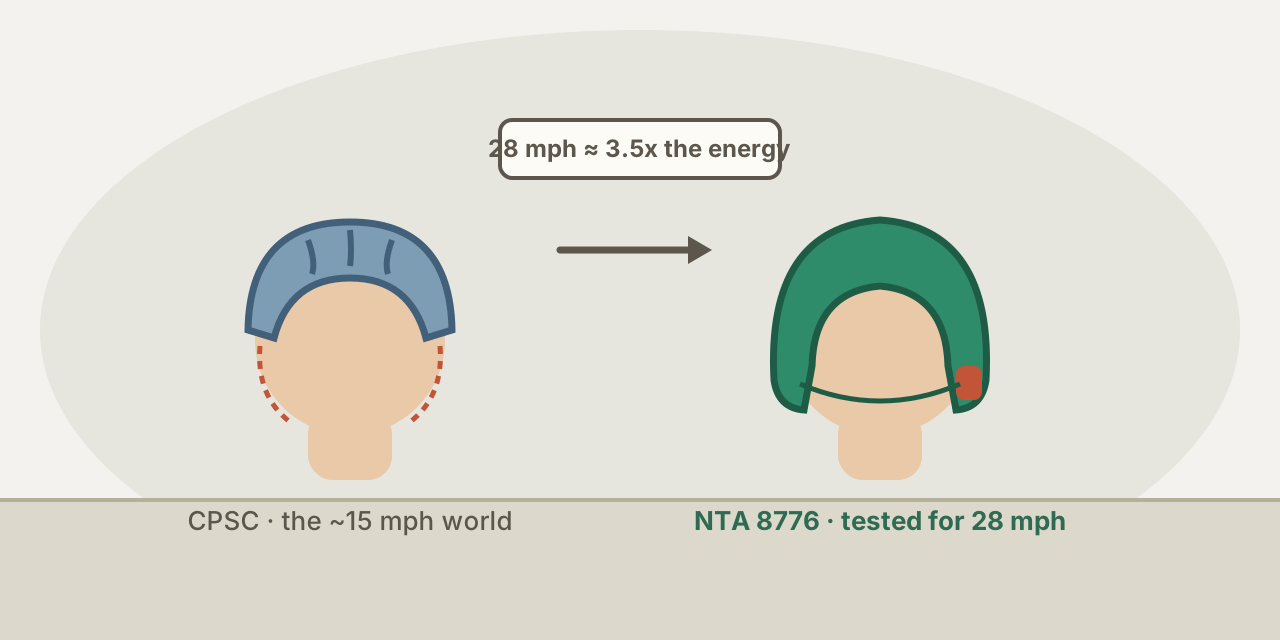
NTA 8776 is the only helmet standard written for e-bike speeds. The CPSC certification on every bicycle helmet sold in the US is a decades-old standard built around ordinary bicycle impact energies — roughly the 12-15 mph world. NTA 8776, a Dutch standard created in 2015 for speed pedelecs, tests helmets against higher-energy impacts corresponding to assisted speeds up to 45 km/h (28 mph) and requires coverage over more of the head — notably the temples and the back of the skull, the areas most exposed in a faster fall.
If you ride a Class 3 e-bike, the case is straightforward: your assisted cruising speed is roughly double the speed world your CPSC helmet was designed around, and impact energy scales with the *square* of speed — 28 mph carries about three and a half times the energy of 15 mph. An NTA-certified helmet is the piece of gear priced most reasonably against what it protects.
For most riders, the XNITO dual-certified helmet is the buy — CPSC and NTA 8776 certified, with USB-rechargeable front and rear LEDs built in, at just under a pound and a price that undercuts most uncertified "urban" lids. If you want integrated smart lighting and a drop-down shield, the Lumos Ultra E-Bike is the NTA-certified upgrade; if you want MIPS rotational protection in a commuter shape, Bern's Hudson MIPS is the third leg.
One honest caveat before the details: no US law requires NTA 8776, marketing phrases like "e-bike rated" are not a certification, and the standard says nothing about rotational impacts — that is what MIPS-type liners address, and the two are complements, not competitors.

The gap nobody put on the box
Here is the uncomfortable arithmetic at the center of this page. The CPSC standard — 16 CFR Part 1203, the certification legally required on every bicycle helmet sold in the US — was written in the 1990s around the impact energies of ordinary cycling, a world that mostly happens between 10 and 15 mph. A Class 3 e-bike assists to 28 mph, and plenty of commuters actually cruise there.
Kinetic energy scales with the square of speed. Going from 15 to 28 mph does not roughly double the energy your helmet may be asked to manage — it multiplies it by about three and a half. Nothing about the foam in a standard helmet knows this happened. The helmet you wore on an acoustic bike is not suddenly useless on an e-bike; it is simply being asked a question it was never tested on.
The Dutch — who adopted e-bikes earlier and harder than anyone — noticed, and in 2015 their standards institute published NTA 8776, the first helmet standard written specifically for e-bikes and speed pedelecs (the European 45 km/h class, legally equivalent in speed to our Class 3). In the Netherlands an NTA-certified helmet is mandatory on speed pedelecs. In the US it is entirely voluntary, which is why most riders have never heard of it — and why the helmets that carry it are worth knowing by name.
If this feels familiar, it is the same story we told about lock certifications in our Sold Secure Powered Cycle explainer: e-bikes quietly outgrew the testing standards of the acoustic-bike world, and the labels that caught up are the ones worth reading.
What NTA 8776 actually tests differently
Strip away the standards-body language and NTA 8776 differs from an ordinary bicycle helmet certification in three concrete ways:
Higher impact energy. Certification testing drops the helmet at higher velocity, corresponding to the crash energies of 45 km/h-class riding. The practical consequence is denser or thicker energy-absorbing foam — an NTA helmet has to soak up meaningfully more energy without transmitting it to the headform.
More head covered. The standard requires protection over a larger area, extending lower at the back of the skull and further around the temples. Look at an NTA-certified lid next to a vented road helmet and you can see the difference without reading anything: the shell simply comes down further, closer to a skate-style silhouette than a racing one. At higher speeds, falls are more likely to involve the back and sides of the head — the standard follows the injury pattern.
What it deliberately does not cover: rotational impacts. NTA 8776, like CPSC, measures linear energy management. The angled-impact problem — your head hitting the ground obliquely and rotating — is what MIPS and similar slip-plane liners exist for, and a helmet can carry both (the Bern below does). Treat them as answering two different questions about the same crash.
Two label warnings, because the marketing here is genuinely messy. First, "e-bike rated" is a phrase, not a certification — some helmets advertise speed numbers from private testing that is not an NTA 8776 certification. Second, the certification lives on the sticker inside the helmet, not the product page: if buying specifically for NTA 8776, confirm the marking on the physical helmet, since product lines sometimes carry the certification on some variants and not others.
Who actually needs one
Class 3 riders: yes, without much debate. At 28 mph assisted you are riding at exactly the speed the standard was written for, and a CPSC-only helmet leaves the gap the arithmetic above describes. This is the clearest buy-signal in e-bike safety gear.
Class 1 and 2 riders: a judgment call, tilted by how you actually ride. At a 20 mph assist ceiling you are already above the speed world the CPSC standard grew up in, just less dramatically. The honest questions are about your riding, not your bike's class sticker: heavy commuting in traffic, a loaded cargo bike (more mass, more energy, harder to save a fall), long fast descents, or a bike that spends every ride at its ceiling all push toward the certified lid. A neighborhood cruiser that rarely sees 15 mph pushes back.
The price argument has mostly evaporated. NTA-certified helmets once carried a serious premium; the XNITO below routinely sells in the same band as ordinary mid-range commuter helmets. When the certified option costs about the same as the uncertified one, the decision stops being interesting — which is the best thing that can happen to a safety category.
One more frame that belongs in this decision: a helmet is the cheapest component in the crash. We have made this point before about locks and what thieves actually do — the gear that protects the expensive thing should be priced against the thing, and your head is the expensive thing.
Which helmet for which rider
| Your riding | What to get | Why |
|---|---|---|
| Class 3 commuter, wants certified without a premium price | XNITO dual-certified | CPSC + NTA 8776 with built-in front and rear USB-rechargeable LEDs, about 0.9 lb, priced with ordinary commuter lids. |
| Wants the full smart-lid package — lights, shield, app | Lumos Ultra E-Bike | NTA 8776 certified with app-controlled front and rear LEDs and a retractable face shield for cold-morning commutes. |
| Wants rotational protection in a low-profile commuter shape | Bern Hudson MIPS | E-bike-rated protection per Bern with a MIPS liner, integrated rear LED, and U-lock-through-the-vent compatibility, about 0.8 lb. |
| Class 1 cruiser, short slow rides | Your current CPSC helmet, honestly | Below the speeds where the certification gap opens up, a well-fitted, undamaged CPSC lid is a defensible answer. |
| Any helmet that has been in a crash | A new one, whatever the sticker says | Impact foam is single-use: it manages energy by crushing. A helmet that has done its job once is done. |
What we would buy
Selected on certification status, published specifications, and price positioning. EbikeTested has not impact-tested helmets — nobody outside a certified lab should — so certification claims here come from the manufacturers' listings and documentation, verified as live Amazon listings the day this was published. Helmet sizes have separate listings: measure your head circumference and buy from the size chart, not the default variant. Prices move constantly, so we do not quote them.
Start hereXNITO E-Bike Helmet
The value case for the whole category: dual CPSC and NTA 8776 certification, integrated USB-rechargeable front and rear LEDs with three modes, a fidlock-style magnetic buckle, and a listed weight of about 0.9 lb — at a price that sits alongside ordinary uncertified commuter helmets. The built-in lighting also quietly solves the be-seen half of the problem our winter visibility guide covers.
Check price on Amazon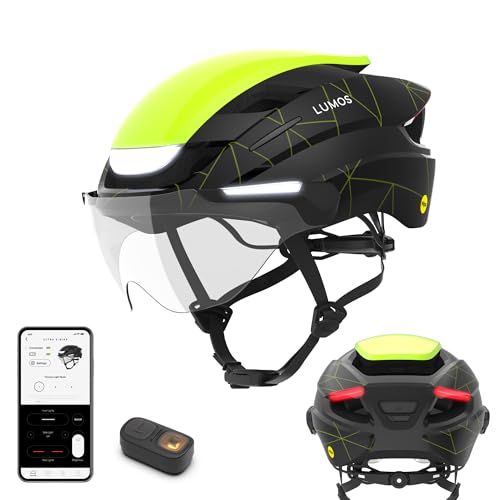 The smart lid
Lumos Ultra E-Bike
NTA 8776 certified with the most complete feature set here: app-controlled front and rear LEDs, a retractable face shield that earns its keep on cold or buggy commutes, and Lumos's turn-signal ecosystem if you add the remote. You are paying for electronics on top of certification — worth it if you will actually charge and use them, redundant if you already run good bar-mounted lights.
Check price on Amazon Rotational + rated
Bern Hudson MIPS
The one to pick if MIPS is your priority: Bern rates the Hudson for e-bike impacts (the listing states protection up to 27 mph) and pairs it with a MIPS rotational liner, an integrated USB-rechargeable rear light, and a vent shaped to take a U-lock while you shop. Listed at about 0.8 lb. Skate-adjacent coverage that comes down over the back of the head — visibly more helmet than a road lid.
Check price on AmazonThe certification only works at the fit it was tested at. Level on the head — two fingers above the eyebrows, not tilted back like a cap; straps forming a Y just under each ear; snug enough that the helmet moves your eyebrows when you wiggle it. And two replacement rules that outrank every sticker: replace after any crash where the helmet touched down (the foam manages energy by crushing, once), and replace on age — manufacturers generally say five years or so as materials degrade. A perfectly certified helmet worn loose and backward protects like neither certification.
Frequently Asked Questions
Is NTA 8776 legally required for e-bikes in the US?
No. US law requires bicycle helmets to meet CPSC; helmet-wearing laws themselves vary by state and by e-bike class, and none currently name NTA 8776. The standard is mandatory only for speed pedelec riders in the Netherlands and referenced in a few other European rules. In the US it is a voluntary buy — which is exactly why it is worth checking for deliberately, because no regulation will check it for you.
Is a MIPS helmet or an NTA 8776 helmet safer?
They answer different questions, so neither substitutes for the other. NTA 8776 raises the bar on linear impact energy and coverage area; MIPS-type liners address rotational forces in angled impacts. The strongest combination is a helmet that carries both, like the Bern here. If you must choose one and you ride at Class 3 speeds, the coverage and energy margin of NTA 8776 addresses the specific risk your bike added; MIPS addresses a risk every rider always had.
Do NTA 8776 helmets have worse ventilation?
Generally yes, somewhat — more coverage and more foam mean fewer and smaller vents than a road-racing lid, and it is the honest tradeoff of the category. For commuting at e-bike speeds the airflow you generate offsets a lot of it. If your riding is long summer climbs where you are working hard at low speed, a heavily vented CPSC helmet may genuinely serve you better than a certified one you leave at home.
My helmet says "e-bike rated to 27 mph" — is that NTA 8776?
Not necessarily, and this is the label trap of the category. Some manufacturers test to speed figures in private or third-party protocols and describe the result as an e-bike rating without holding NTA 8776 certification; others certify some sizes or variants of a line and not others. The certification lives on the label inside the helmet. If NTA 8776 specifically is what you are buying, look for the standard named on the helmet itself and on the manufacturer's spec page, not just a speed number in marketing copy.
How often should I replace an e-bike helmet?
After any impact, immediately and without negotiation — the EPS foam does its job by permanently crushing, so a helmet that has hit the ground once has spent its protection even if it looks fine. Absent a crash, follow the manufacturer's age guidance, typically around five years, as foams and shells degrade with UV and sweat. And re-check fit yearly: pads compress, straps stretch, and the certification assumes the helmet actually sits where it was tested.
Where this fits
A helmet is one line in the safety budget, and the cheapest one. The lighting half of not-getting-hit is covered in e-bike lights and winter visibility — and note the helmets above with built-in LEDs count as *additional* lights, not replacements for a real headlight. If you are working through what a new e-bike actually needs in its first months, the helmet belongs ahead of everything in the first upgrades guide — comfort upgrades can wait a paycheck; the thing protecting your head at 28 mph should not.
The short version: the speeds changed, the default sticker did not. If your bike does 28, buy the helmet tested at 28 — especially now that it costs the same as the one that wasn't.