How E-Bikes Actually Get Stolen: Battery, Display, and Whole-Bike Theft
An e-bike is three thefts in one: the bike, the battery, and the display, each with its own resale market and its own defense. Here is what the documented numbers show, where the data is thin, and how riders actually layer protection.
Some links below are affiliate links. If you buy through them, EbikeTested may earn a commission at no extra cost to you. Commissions never touch a score, and the failures get published anyway. Full details on our affiliate disclosure page.
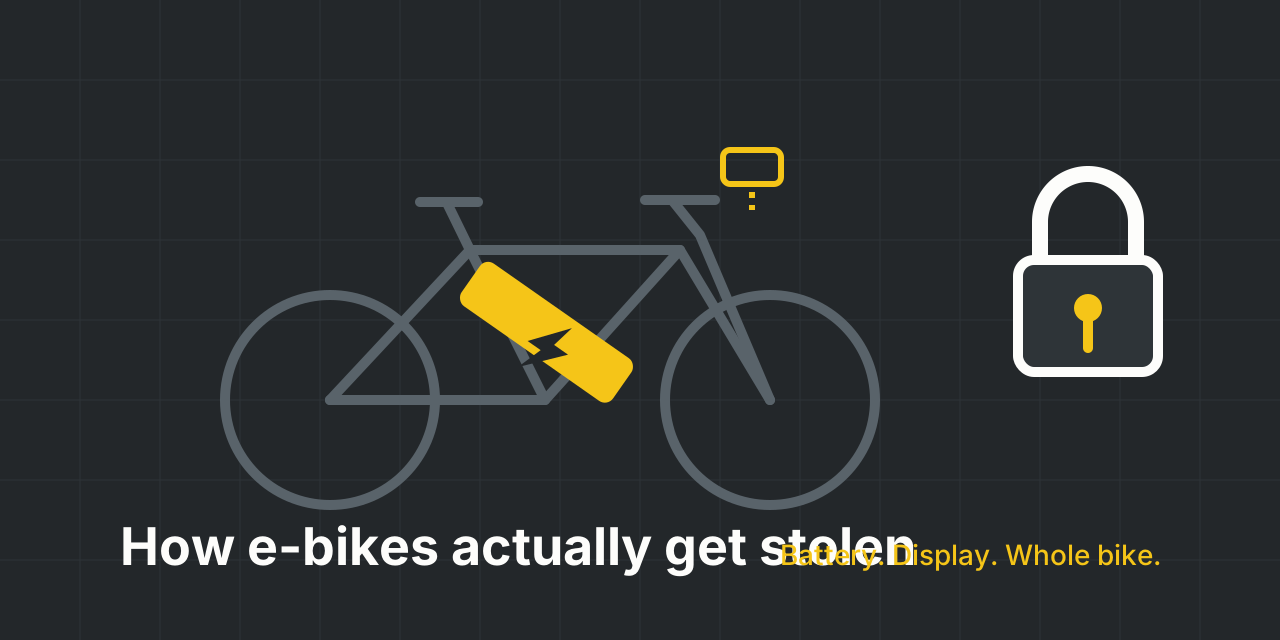
An e-bike is three thefts in one. The whole bike falls to portable power tools that go through ordinary locks quickly. The battery, worth several hundred dollars on its own, releases from its mount with a cheap lock or a pry bar and resells fast. And many displays pop off a handlebar mount in seconds. The documented numbers are real: Bike Index logged a 15 percent rise in reported stolen bikes in 2024, London's Met Police recorded 2,966 powered cycle and e-bike thefts in 2025, the highest on record, and Dutch police counted roughly 4,500 stolen e-bike batteries in a single year. Generic bike-lock advice covers exactly one of the three thefts. The answer is layers: a Sold Secure Powered Cycle rated lock, taking the battery and display with you, a hidden tracker, free registration, and insurance for whatever gets through. This article is sourced research, not our test data: our lock lab's timed destruction round is still ahead.

An e-bike is three thefts in one
Most theft advice you will find for e-bikes is recycled bicycle advice: buy a good U-lock, lock the frame, park somewhere visible. All of that still applies, and none of it addresses what makes an e-bike a different target.
A conventional bike is one thing to steal. An e-bike is three:
- The whole bike, typically worth 1,000 to 6,000 dollars, with an established resale and parts market.
- The battery, a removable component that is often the single most valuable part of the bike. Dutch authorities investigating that country's battery-theft wave put the resale value of a single pack at more than 500 euros, and replacement packs from major brands routinely retail for 500 to 900 dollars.
- The display, a small computer that on many bikes sits in a quick-release handlebar mount, comes off with one hand, and resells as a spare part.
A thief does not need to defeat your frame lock to take two of those three. That is the e-bike specific gap this article is about, and it is why a rider with a 150 dollar lock can still walk back to a bike that no longer switches on.
What the numbers actually show, and where they are thin
Theft data in this space is patchy, so here is what is documented, with sources, and what is not.
Bikes overall, United States. Bike Index, the largest free bike registry with over 1.3 million registered bikes, reported a 15 percent increase in stolen-bike reports in its registry in 2024. It estimates around 2.4 million bikes stolen per year in the US, worth roughly 1.4 billion dollars, with 59 percent of thefts happening in residential areas: your garage, your building's bike room, your yard.
E-bikes, London. Metropolitan Police figures obtained by freedom of information request and reported by London TV show powered cycle and e-bike thefts climbing from 2,171 in 2021 to 2,448 in 2024 and 2,966 in 2025, a 21 percent one-year jump and likely the highest figure on record.
E-bikes, Netherlands. The Dutch are the leading indicator for e-bike theft because e-bikes saturated their market first. Police counted over 86,000 stolen bikes reported in 2024, with Amsterdam alone at 11,000, and told DutchNews the rise tracks demand for expensive e-bikes and increasingly professional theft methods. Only about 5 percent of stolen bikes there are recovered.
Batteries specifically. This is where the Netherlands data gets striking: Dutch police counted roughly 4,500 e-bike batteries stolen in 2022, about three times the previous year's figure, as reported by NL Times. Battery theft became visible enough in Europe that Bosch, the biggest mid-drive system maker, shipped a digital battery lock in 2025 that makes a stolen pack refuse to power any other bike.
The honest gap: no US agency publishes e-bike battery theft counts. American police reports generally file a stolen battery under generic larceny, so there is no clean US number, only news coverage of theft waves hitting delivery riders in cities like New York, where CBS has covered strings of e-bike robberies targeting couriers. We will not invent a US prevalence figure where none exists. The European data and the manufacturer response are the evidence that the battery is a theft target in its own right.
Theft one: the whole bike
The mainstream, widely reported reality is that battery-powered angle grinders changed urban bike theft. A portable grinder goes through most ordinary U-locks and chains in well under a minute, a fact demonstrated openly for years by security reviewers and acknowledged by the lock industry itself, which now sells grinder-resistant models as a distinct category. We are not going to detail technique here. The defense-relevant facts are these:
- Lock ratings now have an e-bike tier. Sold Secure, the UK testing house whose ratings many insurers write directly into policy requirements, added a Powered Cycle category with higher attack standards than its pedal-cycle tiers. A handful of locks hold Powered Cycle Diamond, the top rating, largely because they resist grinder attack: the Hiplok D1000, which Hiplok says is around 20 times more grinder-resistant than a standard D-lock thanks to a graphene composite, and the LITELOK X series are the best known.
- Where you park matters more than riders assume. Bike Index's data putting 59 percent of thefts at residential locations means the bike room, shed, and garage deserve the same lock discipline as the street rack.
- Speed favors the thief. News coverage of e-bike theft consistently describes fast, targeted work, and in the worst cases straight robbery of delivery riders. No lock buys infinite time; good locks buy noise, sparks, and minutes instead of seconds.
Our Security Lab's first destructive round will put timed power-tool runs against exactly these claims, on camera, with retail-bought locks. Until that publishes, treat every resistance claim above as the manufacturer's or the certifier's, not ours.
Theft two: the battery
The battery is the e-bike theft story that generic lock advice misses entirely, and the economics explain it. A lithium pack is compact, anonymous, cash-convertible, and on many bikes it is designed to come off in seconds, because commuters need to charge indoors. The same convenience serves the thief.
Why it pays. Replacement packs from name brands retail in the 500 to 900 dollar range, Dutch authorities cite over 500 euros of resale value per stolen pack, and there is a liquid secondhand market with no title system: no serial check at point of sale, no registration, nothing that flags a hot battery.
How they go, at the level already public. Battery mounts on most bikes are secured by a small cylinder lock. Reporting on the European battery-theft wave and years of forum discussion describe two realities: cheap battery locks can be defeated or simply pried past quickly, and key blanks are shared across huge production runs. Owners on the Rad Power Bikes owners forum have reported that a key from one bike opened the battery lock on another owner's bike, which is worth knowing as a forum-reported anecdote we have not independently verified: the battery cylinder on a mass-market bike is a convenience latch, not a security device.
Where stolen packs end up matters for everyone. Stolen batteries feed the secondhand market, and secondhand lithium packs with unknown history are exactly what fire investigators warn about. Consumer Reports' reporting on e-bike fires notes investigators often cannot trace fire-linked batteries because they were bought secondhand online. London Fire Brigade data reported by the BBC recorded 155 e-bike fires in 2023, up 78 percent in a year. Battery theft is not just a property crime; it is a supply chain for the sketchiest packs on the market.
The industry response confirms the problem. Bosch's 2025 eBike Lock update makes its smart-system batteries digitally lock to the owner's bike, so a stolen pack will not run another Bosch bike and even disables that bike's motor. That is a major manufacturer spending engineering budget on battery theft specifically. It also only helps on new Bosch smart-system bikes; the installed base of hub-drive commuter bikes has none of it.
Theft three: the display
The display is the smallest, easiest, least reported theft of the three. Many mid-drive bikes ship with a head unit that sits in a quick-release mount: Bosch's Intuvia and Kiox, and comparable units from other systems, lift off the handlebar without tools by design, so you can take them inside. Left on a parked bike, they come off just as easily for anyone else, and replacement displays sell as parts, often dealer-only and expensive.
Two useful facts, both from the manufacturer side:
- On newer Bosch smart-system bikes, the Kiox 300 and 500 can be configured as a key: remove the display and the bike's motor support locks until it returns or the owner's phone unlocks it. That turns the display from a theft target into a theft defense, but only if you actually pocket it when you park.
- On many older or simpler systems, the bike will not run properly without its display, which means a 30-second display theft can strand the whole bike and cost hundreds in dealer parts to fix.
The habit is the defense: if the display comes off without tools, it leaves with you, every time, exactly like the battery.
The three thefts, side by side
| Theft type | What is taken | Why it pays | Defense layers that matter most |
|---|---|---|---|
| Whole bike | Everything: bike, battery, display, accessories | 1,000 to 6,000 dollar resale or parts value; liquid secondhand market | Sold Secure Powered Cycle rated lock, locked indoor parking, hidden GPS tracker, registration, insurance |
| Battery only | The pack, often the most valuable single component | Several hundred dollars per pack; anonymous cash resale; no serial checks at sale | Take the battery with you; secondary battery lock; digital battery lock where the system offers it; record the pack serial |
| Display only | Head unit from a quick-release handlebar mount | Sells as a dealer part; seconds to take; near-zero risk | Pocket the display every time you park; configure display-as-key where supported |
| Robbery of the rider | The whole bike, taken in person | Targets delivery riders on high-value bikes with predictable routes | Route and stop awareness, trackers for recovery, insurance; no lock helps while riding |
Layered defense: what actually stacks
No single purchase solves three different thefts. What the documented evidence supports is layers, cheapest habits first:
- Take the battery and display with you. Free, and it removes the two components a frame lock cannot protect. If you charge indoors anyway, this is zero extra effort for public parking.
- Buy the lock for the bike you actually own. For an e-bike, the relevant standard is Sold Secure Powered Cycle, the tier insurers reference for powered bikes; Diamond is the top of it, and the current Diamond holders are the grinder-resistant designs. Our destructive round will test how those ratings hold up; the ratings themselves are the best independent signal available today.
- Add a battery-specific lock if your pack stays on the bike. Aftermarket locks exist that replace or supplement the stock battery cylinder, including higher-security cores for common systems, and cafe-stop cables that pass through the battery handle. None of these are rated like frame locks; treat them as delay, not prevention.
- Hide a tracker, and know the two types. Crowd-network tags like an AirTag or a Knog Scout are cheap, with the Scout adding an 85 dB alarm, but they update only when a phone passes nearby and are findable by a thief who scans for them. Cellular GPS units like the PowUnity BikeTrax hide inside the motor area of compatible mid-drives, track continuously, and cost more plus a subscription. Trackers do not prevent anything; they convert a theft into a recovery chance, ideally one you hand to police rather than pursue yourself.
- Register, free, before anything happens. Bike Index and 529 Garage are free registries used by shops and police. Vancouver's police-backed 529 rollout coincided with a roughly 30 percent drop in reported theft, per CBC reporting. Record the frame serial, the battery serial, and the display serial; the bike is not the only thing you may need to prove you own.
- Insurance is the layer that pays when the others fail. Homeowners and renters policies often cap bike payouts or exclude e-bikes above certain speeds, and battery-only theft can fall under the deductible. Specialty e-bike policies exist, and in some markets they require a rated lock to pay out. Read the theft conditions before you need them; we cover this in a separate piece.
Defense hardware worth researching
These are the categories and models our research keeps surfacing, chosen for documented ratings or documented mechanisms, not our own testing. Nothing here has been on our bench yet: the Security Lab's timed destruction round is where these claims get checked. Links are Amazon searches, disclosed per our affiliate policy.
Grinder-resistant benchmarkHiplok D1000 U-lock
The lock that created the anti-grinder category. Sold Secure Powered Cycle Diamond rated, with Hiplok claiming roughly 20 times the grinder resistance of a standard D-lock via its Ferosafe composite. Heavy and expensive, which is the honest trade. First on our destructive-test list.
See on AmazonLITELOK X1
The other widely available Sold Secure Powered Cycle Diamond design, using a ceramic composite armor. Independent reviewers rank its grinder resistance below the D1000 but its weight and price make it the rated lock people actually carry. Also queued for our timed round.
See on Amazon Budget tracking layer
Knog Scout tracker and alarm
Bolts under a bottle cage, runs on Apple Find My, and adds an 85 dB motion alarm that a plain AirTag lacks. Crowd-network tracking means updates depend on passing iPhones, so treat it as a recovery aid and a noise-maker, not a lock.
See on AmazonPowUnity BikeTrax GPS
Hides inside the motor area on compatible Bosch, Shimano, Yamaha, Brose and Giant systems and reports position over cellular, continuously, not just when a phone walks by. Not carried on Amazon in the US, so this is a direct link and we earn nothing from it — the full reasoning is in our GPS tracker roundup. Recovery stories in the press are promising; we have not verified them ourselves.
See it at PowUnity (not an affiliate link)Fair questions
Are e-bikes really stolen more than regular bikes?
The strongest documented signals say the risk is rising where e-bikes are common. London's Met Police recorded a record 2,966 powered cycle and e-bike thefts in 2025, up 21 percent in a year, and Dutch police attribute their national rise in bike theft reports to expensive e-bikes and professional theft methods. Clean US e-bike-versus-bike comparison data does not exist yet, and we will not pretend otherwise. What is certain is that the average e-bike is worth several times the average bike, and thieves price targets the same way anyone does.
Should I really take the battery with me every single time?
For public parking, yes, if your pack releases without tools. It is the one defense that costs nothing, cannot be cut, and removes the most valuable component from the equation entirely. Dutch police counted around 4,500 stolen e-bike batteries in one year, and the stock cylinder lock holding most packs is a convenience latch. If carrying the pack is impractical, a secondary battery lock and a locked indoor parking spot are the fallback layers.
Is an AirTag enough to protect my e-bike?
No, and it does not claim to be. Crowd-network tags update only when a compatible phone passes nearby, thieves know to scan for them, and a tag prevents nothing at the moment of theft. They are a cheap recovery layer that sometimes works, stacked behind a rated lock and battery removal. Cellular trackers hidden in the motor area track continuously but cost more plus a subscription. Either way, hand locations to police rather than confronting anyone yourself.
Does registering with Bike Index or 529 Garage actually do anything?
It is free and the documented results are real. Bike Index has over 1.3 million bikes registered and shops and police check it; Vancouver's police-backed 529 Garage rollout coincided with a roughly 30 percent drop in reported thefts per CBC reporting. Registration mostly pays off at recovery time: without a recorded serial, a recovered bike often cannot be returned. Record the battery and display serials too, since those can be stolen separately.
What lock rating should an e-bike owner actually look for?
Sold Secure Powered Cycle is the tier written for powered bikes, and it is the wording UK insurers commonly require; ART ratings play a similar role in the Netherlands. Powered Cycle Diamond is the top of the range and currently belongs mostly to grinder-resistant designs like the Hiplok D1000 and LITELOK X series. Those ratings are the manufacturer-independent signal we trust most today. Our own timed destruction testing is coming, and the ratings will be exactly what we test against.
Has EbikeTested tested any of these locks or trackers?
No. Nothing in this article is our test data. Every number here is sourced to registries, police figures, fire-service data, or named press coverage, and every product claim belongs to the manufacturer or certifier. The Security Lab's first retail-bought lock purchases and timed power-tool runs are the next phase, and when those results exist, this page will link them.
What we're doing about it
This article is the research that decides our first shopping list. The Security Lab's opening round is exactly what this post cannot yet give you: retail-bought locks, measured weight against claimed, fat-tube fit checks, then timed destruction runs on camera, framed around the Sold Secure Powered Cycle tier that insurers already use. Battery security is on the bench after that, including what the stock cylinder locks on mass-market packs actually resist.
If there is a lock, battery lock, or tracker you want on the bench first, tell us. If your battery or display has been stolen, we want the report: what bike, what was taken, how it was parked, and what the replacement cost. That data feeds the same database as our Died Early failure log, and it stays anonymous.