Which Hiplok Is Right for an E-Bike? The Whole Range, by the Rating That Matters
Hiplok makes three security tiers and the model names do not tell you which is which. Here is the range sorted by Powered Cycle rating, the verified weights, why choosing between the D1000 and the DX1000 is a fit question rather than a security one, and what a real multi-lock stack actually costs and weighs.
Some links below are affiliate links. If you buy through them, EbikeTested may earn a commission at no extra cost to you. Commissions never touch a score, and the failures get published anyway. Full details on our affiliate disclosure page.
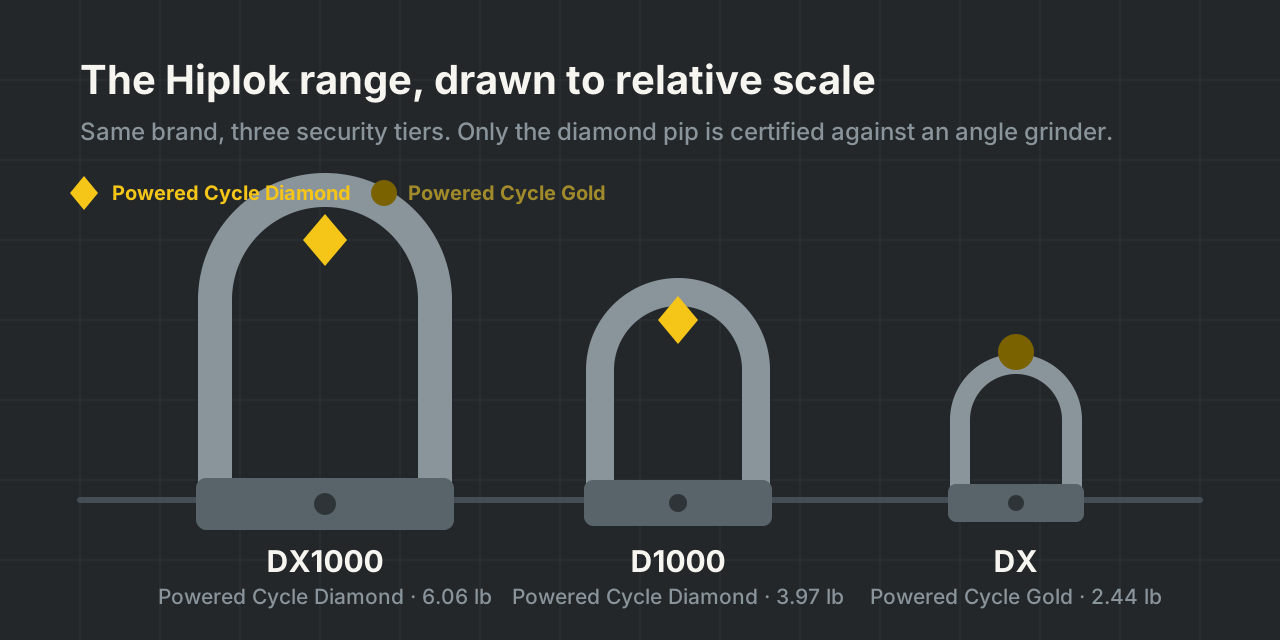
Hiplok sells locks at three different security tiers, and the model names actively hide which is which. Only the 1000 Series, meaning the D1000 and the DX1000, holds Sold Secure Powered Cycle Diamond, the single consumer tier whose certification test includes angle grinders. The DX, DXC and E-DX sit one rung lower at Powered Cycle Gold, which by Sold Secure's own description is the same test as Pedal Cycle Diamond. And the Hiplok Gold chain's name is a product name, not a Powered Cycle grade.
For an e-bike that parks outdoors in a city, that narrows the whole catalogue to two locks. The D1000 weighs a verified 3.97 lb and suits most e-bike frames. The DX1000 weighs a verified 6.06 lb and exists for frames and tyres the D1000 will not close around. They carry identical certification, so choosing between them is a question about your bike's geometry, not about security. Everything else in the range is a second lock, a light-duty lock, or in the case of the MD1000, a motorcycle disc lock that secures your bike to nothing at all.
Three tiers, one brand, and a naming scheme that buries the difference
Hiplok is the brand people land on when they start reading about angle grinders, and for good reason: the 1000 Series was one of the first consumer bike locks built specifically around grinder resistance rather than around bolt cutters. But the catalogue now spans a wide range, and the model names are not a ladder. DX1000 and DX sound like siblings. They are two tiers apart.
The rating that matters for an e-bike is the Sold Secure Powered Cycle grade, not the Pedal Cycle grade and not the number in the model name. We set out why in Sold Secure Powered Cycle, explained, and the short version is worth repeating here because it decides this entire page:
Powered Cycle Diamond is the only consumer tier whose published attack list includes angle grinders and power tools. Everything below it, including Pedal Cycle Diamond, can be earned by a lock that never met a grinder during certification. Sold Secure states on its own ratings page that Powered Cycle Gold and Pedal Cycle Diamond are the same test with two names.
So when a Hiplok product page says "Diamond rated," the useful follow-up question is always: Diamond in which category? For the DX and DXC, the honest answer is Pedal Cycle Diamond, which is Powered Cycle Gold. For the D1000 and DX1000, it is both, and the Powered Cycle Diamond is the one you are paying for.
One caveat we will not paper over. Sold Secure certifies pass or fail at a grade and does not publish how long any lock survived, which tool defeated it, or how close the pass was. You will find confident cut times attributed to these tiers around the internet. They are not on Sold Secure's pages and we are not going to launder them into fact. A certification tells you which test a lock passed. It does not tell you how many seconds you have.
The Hiplok range, sorted by the rating that applies to an e-bike
| Model | Powered Cycle grade | Weight | What it is actually for |
|---|---|---|---|
| D1000 | Diamond | 3.97 lb | The default grinder-rated Hiplok for most e-bikes. Compact opening, so measure before you buy. |
| DX1000 | Diamond | 6.06 lb | Identical certification, larger opening. Buy it when the D1000 will not close around your frame, stand or tyre. |
| MD1000 | Diamond, plus ART 4 | About 1 kg (maker's figure) | A motorcycle disc lock. It immobilises a wheel and secures the bike to nothing. Not a parking lock. |
| DX | Gold, which is Pedal Cycle Diamond | 2.44 lb | The wearable light tier. Clips to a belt. Not certified against a grinder. |
| DXC | Gold, which is Pedal Cycle Diamond | Not published in listing data | The DX plus a cable for a second wheel or a saddle. |
| E-DX | Gold-tier D-lock with a chain | Not published in listing data | The combo Hiplok markets at e-bikes and cargo bikes. Reach, not grinder resistance. |
| Gold Wearable Chain | "Gold" here is the product name | Not published in listing data | A wearable chain. Check its category and grade in the certifier's database before treating the name as an e-bike rating. |
Where these weights came from, and why we are using them
Every weight in the table above is the figure Amazon publishes in its own structured product data for that listing, retrieved 2026-08-18. We are using those rather than marketing copy because they are the same numbers for everyone and they can be checked.
They also happen to corroborate Hiplok's own claims closely. Hiplok describes the D1000 at around 1.9 kg; the listing data says 3.97 lb, which is 1.80 kg. Hiplok describes the DX at around 1.1 kg; the listing says 2.44 lb, or 1.11 kg. When a maker's claim and the retail listing data agree to within a rounding error, the number is probably real.
Where a listing publishes no weight, the table says so instead of guessing. EbikeTested has not put any of these locks on a scale, and has not cut any of them.
D1000 or DX1000: this is a fit question, not a security question
This is the decision most people are actually trying to make, and almost every discussion of it gets framed as though the DX1000 is the more secure lock. It is not. Both hold Sold Secure Powered Cycle Diamond and Pedal Cycle Diamond. The difference between them is internal space and the 2.09 lb of extra weight you carry to get it.
Hiplok publishes the D1000's internal opening at roughly 6.1 by 3.6 inches and the DX1000's at roughly 8.07 by 4.41 inches, and describes the DX1000 as the one intended for e-bikes, cargo bikes and motorcycles because of bulkier frame tubes. That framing is right but incomplete, because the frame tube is rarely the binding constraint. Three things have to fit through that opening at once:
The object you are locking to. A thick municipal bike hoop or a scaffolding pole eats more of the opening than your frame does.
Your tyre, if you are locking through the rear wheel. This is where fat-tyre and cargo e-bikes run out of room. A 4-inch fat tyre plus a rim plus a stand post will not go through a compact D-lock.
The frame tube itself, which on a big-battery e-bike down tube is genuinely fat.
The two-minute check before you order anything: take a tape measure to the stand you actually use every day, add your tyre width if you plan to capture the wheel, and compare that against the internal figures above rather than the external dimensions on the box. If the answer is close, buy the DX1000. A lock that does not reach is a lock you stop using, and the more common failure is not a defeated lock but a rider who left the heavy one at home.
One genuine strike against the DX1000 that is worth stating plainly: at 6.06 lb it is heavier than many people will carry daily. If the bike lives in a garage and only sees short daytime stops, the extra reach buys you nothing and the D1000 or even the DX is the more honest purchase.
The stack, weighed and priced
The question that brought most people here is not really which single Hiplok to buy. It is whether a multi-lock setup is worth it. A rider in a recent r/RadPowerBikes thread laid out his plan for a new Radster Trail before a move to a college town: a Hiplok DX1000 on the frame and two smaller u-locks, one on each wheel. He wanted to know whether that was enough.
Run the numbers on that exact stack, using the listing weights above and current US list prices:
Weight. DX1000 at 6.06 lb, plus two compact u-locks at roughly 2 lb each, is about 10.5 lb of hardware. That is a meaningful fraction of what a rider will carry, and on an e-bike it is genuinely manageable in a way it would not be on a road bike.
Cost. The DX1000 lists at $379.99 on Hiplok's US store, and a good compact secondary u-lock runs roughly $60 to $110. Call the stack $500 to $600 as of mid-2026.
Is it enough? Our view, and this is reasoning rather than a measurement:
The stack is sound in principle and the logic is the one we set out in Best E-Bike Locks: a thief arrives with one tool and one plan, and locks that fail to different tools force either a longer attack or a decision to walk. Three locks is three separate jobs.
But the weakest element is almost never the lock. It is the thing you locked to. A hoop that unbolts, a sign post the bike lifts over, a wooden fence rail: none of the three locks matters if the anchor loses. Spend the first minute of every park on the anchor and the second on the locks.
And the two wheel locks are solving the smaller problem. Whole-bike theft is what the frame lock addresses. Wheel and component theft is a real but cheaper loss, and on many e-bikes the wheels are held by axle nuts or thru-axles rather than quick releases, which already raises the effort. If weight or budget forces a cut, cut a wheel lock before you cut the frame lock.
The honest recommendation for most riders is one Powered Cycle Diamond lock capturing the frame and the rear wheel against a fixed anchor, plus one cheap secondary for the front wheel. That is roughly 8 lb and around $450, and it retains most of the benefit. Go to the full three-lock stack when the bike is parked outdoors, in the same predictable place, for hours at a time. Predictability is what makes a bike worth a return visit with the right tool, and that is the situation the third lock is really insuring against.
If you insure your e-bike, read the policy before you buy any lock on this page. Insurers frequently name a specific Sold Secure category and grade, and some will not pay a theft claim if the lock was a tier below what the policy specified. We cover the requirements in which locks your e-bike insurance actually requires.
The picks
Chosen on certification category, published specifications and how each one fits a real parking situation. Weights are from Amazon's structured listing data, retrieved 2026-08-18. Prices are approximate street or list figures as of mid-2026 and they move constantly. EbikeTested has not run a timed destruction round on any lock yet, and nothing here is based on our own cutting.
 Best Hiplok for most e-bikes
Hiplok D1000
Sold Secure Powered Cycle Diamond and Pedal Cycle Diamond. A verified 3.97 lb listing weight with a 32 mm shackle built around Hiplok's Ferosafe composite, which is designed to consume cutting discs rather than resist them outright. This is the right default: it is the cheapest way into the only tier certified against a grinder, and it is light enough that people keep carrying it. Check your stand and tyre against the internal opening before ordering, because the compact size is its real limitation.
Check price on AmazonFor fat tyres and thick framesHiplok DX1000
The same dual Diamond certification as the D1000 in a larger body, at a verified 6.06 lb. Buy this one for a reason, not for reassurance: the extra 2.09 lb buys internal space, and if the D1000 already closes around your frame and your usual stand, the DX1000 gives you nothing except a heavier bag. Where it earns its place is fat-tyre and cargo e-bikes, thick municipal hoops, and anyone who wants to capture the rear wheel and the frame in one lock.
Check price on Amazon Lightest Hiplok worth carrying
Hiplok DX
Powered Cycle Gold, which Sold Secure describes as the same test as Pedal Cycle Diamond. A verified 2.44 lb with a 14 mm shackle and a double deadlock, and the clip that lets it ride on a belt instead of in a bag. Be clear about what you are buying: this tier is not certified against an angle grinder. It is a genuinely good lock for a bike that sleeps indoors and makes short daytime stops, and a poor choice for overnight street parking in a city.
Check price on Amazon Most reach, Gold tier
Hiplok E-DX
A Gold-tier D-lock packaged with a chain, which is the combination Hiplok aims at e-bikes and cargo bikes. What it solves is geometry: the chain reaches around awkward stands, fat tyres and a second wheel that no D-lock will span. What it does not solve is grinder resistance, because it sits at the same tier as the DX. Sensible as a complete kit for a mid-value e-bike, or as the second layer alongside a 1000 Series lock.
Check price on Amazon Best second lock
Kryptonite Evolution Mini-7
Not a Hiplok, and the most useful non-Hiplok purchase on this page. A verified 2.2 lb with a 13 mm hardened shackle and a double deadbolt, plus a cable for the front wheel. Kryptonite lists it as Sold Secure Gold in the pedal cycle category, so it is not a grinder-tier lock and should not be your only one. As the second lock in a stack it is close to ideal: cheap, light, and it fails to different tools than a composite-shackle lock does.
Check price on Amazon Lightest secondary
ABUS Mini Ultra 410
A verified 1.94 lb, the lightest lock on this page, with a 12 mm hardened round shackle. It exists here for one job: the wheel lock in a stack, where the point is to add a second tool requirement at the lowest possible weight penalty. Treat it as a deterrent layer rather than a defence. On its own it belongs on a bike parked briefly and in sight, not on an e-bike left out overnight.
Check price on AmazonThe lightweight commuter tier, and what it actually costs you
There is a real search for the lightest D-lock a commuter can live with, and it deserves a straight answer rather than an upsell.
Here is the weight ladder, using the listing figures throughout: ABUS Mini Ultra 410 at 1.94 lb, Kryptonite Evolution Mini-7 at 2.2 lb, Hiplok DX at 2.44 lb, Hiplok D1000 at 3.97 lb, Hiplok DX1000 at 6.06 lb.
The gap that matters is between the DX at 2.44 lb and the D1000 at 3.97 lb, because that 1.53 lb is the entire price of admission to grinder-certified protection. There is currently no way to buy Powered Cycle Diamond at commuter-lock weight. Litelok's composite locks are the lightest Powered Cycle Diamond products we have found, and even those land near the D1000 rather than near the DX.
So the light tier is a real tradeoff, not a free lunch, and it is the right choice in narrower circumstances than its popularity suggests:
Choose the light tier when the bike sleeps indoors, when stops are short and in daylight, when the bike is usually in sight, or when the alternative is honestly leaving the heavy lock at home. A 2.44 lb lock you carry beats a 6.06 lb lock on a shelf, every time.
Do not choose it for overnight street parking, for a bike left at the same rack on the same schedule, or for anything where an insurance policy names a Powered Cycle grade.
And if you want both, the stack is the answer to that too: a grinder-rated lock that lives in a pannier for the parks you plan, and a wearable Gold-tier lock on your belt for the ones you do not.
Buying a Hiplok for an e-bike: FAQ
Is the DX1000 more secure than the D1000?
No. Both hold Sold Secure Powered Cycle Diamond and Pedal Cycle Diamond, so they carry identical certification. The DX1000 has a larger internal opening and weighs 6.06 lb against the D1000's 3.97 lb. Choose between them on whether the D1000 physically closes around your frame, your tyre and the stand you use, not on a security difference.
Which Hiplok locks are actually rated against angle grinders?
Only the 1000 Series products, which for bikes means the D1000 and the DX1000 and the bundles built from them. Powered Cycle Diamond is the one consumer tier whose certification includes angle grinders and power tools, and it is the only Hiplok tier that holds it. The DX, DXC and E-DX are Powered Cycle Gold, which Sold Secure describes as the same test as Pedal Cycle Diamond.
The Hiplok Gold chain is called Gold. Is that a Powered Cycle Gold rating?
Gold is the product's name. Treat it as a name and look up the specific model in Sold Secure's public database to see which category and grade it currently holds. This matters generally, not just for Hiplok: certifications are per model and can be re-tested or withdrawn, and a badge printed on packaging is not a live record.
What about the MD1000? It is the cheapest 1000 Series lock.
It is a motorcycle disc lock, and it is genuinely Powered Cycle Diamond, but it does a different job. A disc lock clamps a brake rotor so the wheel cannot turn. It does not attach the bike to anything, so it does nothing against two people lifting your e-bike into a van. It is the wrong tool for parking an e-bike in public, whatever its rating says.
Do I need two locks, or three?
Most riders are best served by two: one grinder-rated lock capturing the frame and rear wheel against a fixed anchor, plus a cheap light lock for the front wheel. Go to three when the bike is parked outdoors in a predictable place for hours at a time, because predictability is what makes a return visit with the right tool worth a thief's while. In every configuration, the anchor you lock to matters more than the third lock.
How long will a Powered Cycle Diamond lock survive a grinder?
Nobody publishes a trustworthy answer, including Sold Secure, which certifies pass or fail without releasing attack times. Makers publish their own figures and those are marketing claims until an independent party repeats them. Closing that gap with retail-bought locks and a timed protocol is on our bench plan, and we have not run it yet. Until then, treat certification as a category filter and not as a countdown.
Where this page sits
This is the brand page. If you are choosing across brands rather than within Hiplok, Best E-Bike Locks makes that call by situation and budget. The certification system underneath every rating on this page is set out in Sold Secure Powered Cycle, explained, and the policy requirements that can override your own judgement are in which locks your e-bike insurance actually requires.
If you want the reason any of this matters, how e-bikes actually get stolen covers the attack patterns these locks are answering, including the ones where the lock was never the target.
We buy the gear we write about and we publish the failures. No lock on this page has been cut by us, and we say so wherever a number could be mistaken for a measurement.